

Product discovery is changing quickly.
A shopper no longer has to search for “men’s lightweight running shoes size 11” and work through pages of results. They can ask ChatGPT something much closer to what they actually want:
“I need lightweight running shoes for a half marathon. I have slightly wide feet, I do not want anything bulky, and I would like to stay under $160.”
ChatGPT Shopping can interpret those requirements, find relevant products, compare them, and let the shopper continue refining the decision through conversation.
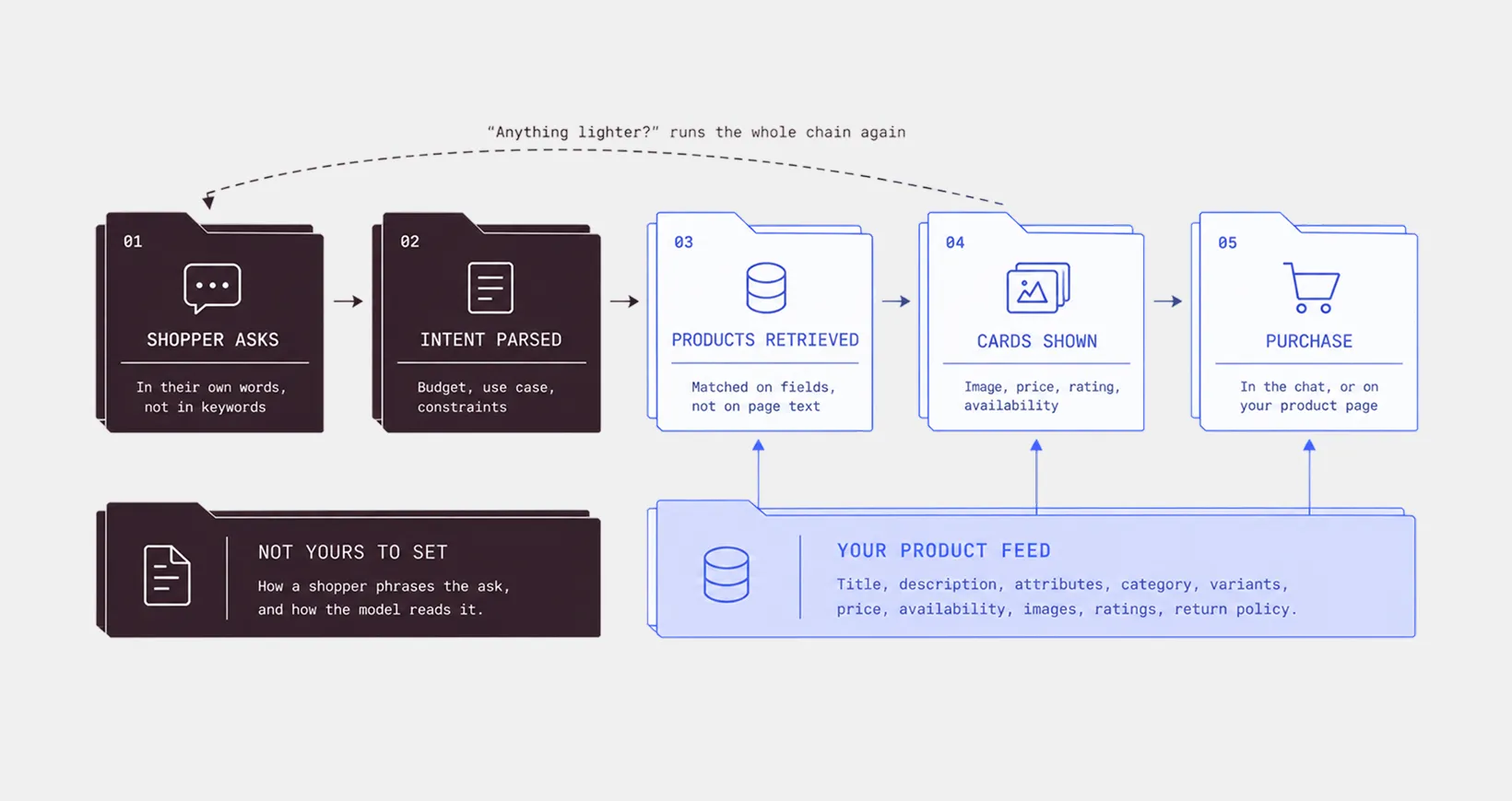
For ecommerce brands, this creates a new discovery surface. The good news is that brands already running Google Shopping are not starting from zero. Much of the infrastructure already exists in the product feed.
The next challenge is making that product data useful enough for AI systems to understand not only what a product is, but when and why it is relevant to a shopper.
How products get listed in ChatGPT shopping
There are several ways product information can become available to ChatGPT.
- For Shopify merchants, product data is integrated with ChatGPT through Shopify Catalog. Individual Shopify merchants do not need to create a separate direct feed integration for their catalog data to participate, although merchant eligibility and storefront settings still apply through Shopify.
- Other merchants can provide product information directly to OpenAI through its commerce infrastructure. OpenAI has expanded the Agentic Commerce Protocol, or ACP, to support product discovery and merchant feeds. It also supports delivery through commerce partners and direct feed integrations.
- OpenAI now documents a Google-compatible product feed option as well. For registered feeds that OpenAI confirms support this format, merchants can use familiar Google-style fields rather than rebuilding the entire catalog around a completely different schema. Core fields include the product ID, title, description, landing page, image, availability, price, and brand.
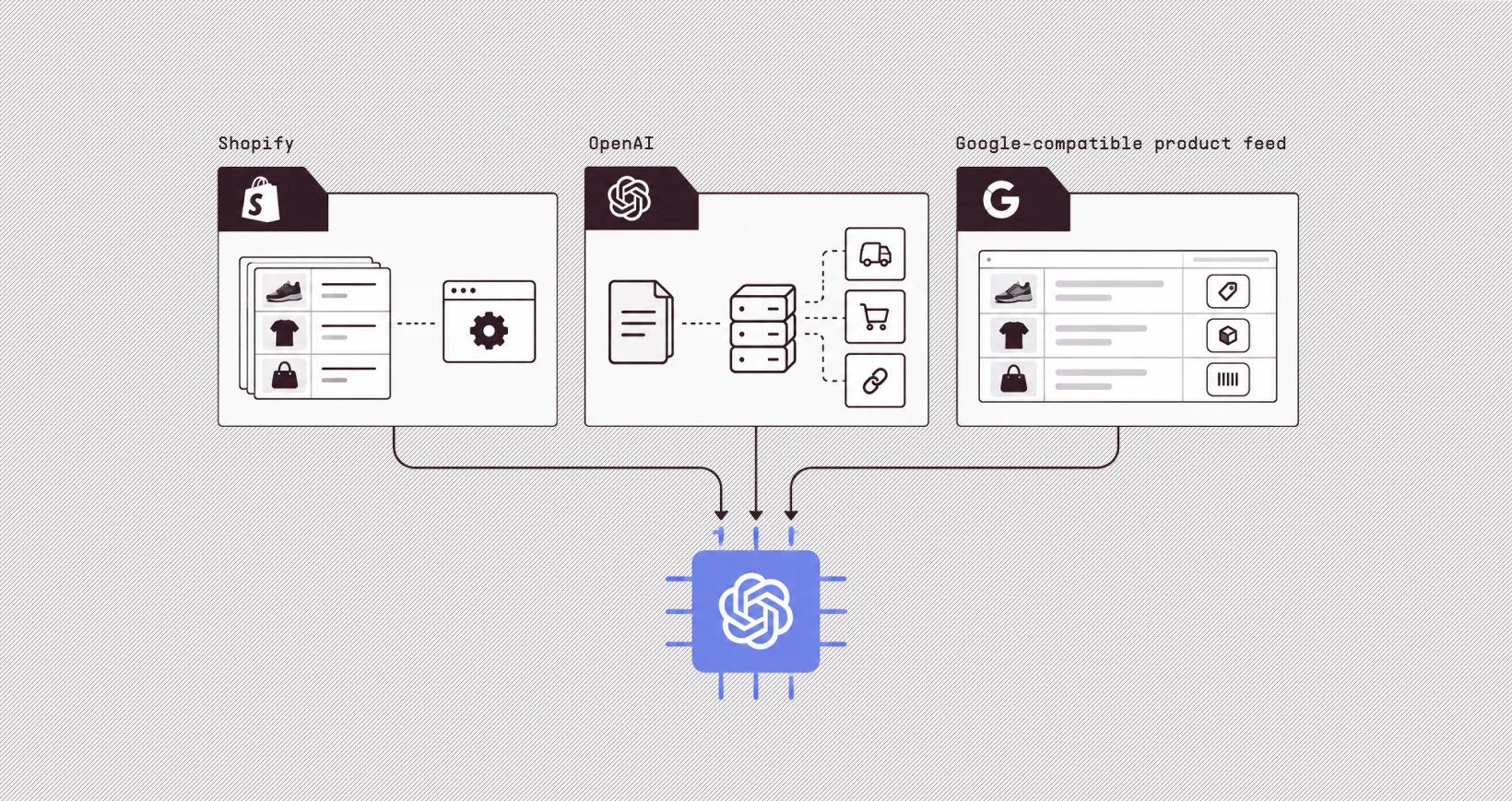
ChatGPT can also use publicly available product information and other retail sources during shopping research. A direct product feed is therefore not the only way ChatGPT can learn about a product, but it gives merchants much more structured and current information to work with.
Remember that paid advertising and organic product recommendations work differently. Buying an ad does not buy a product a better position in organic shopping results, and having Instant Checkout does not automatically improve organic visibility. For brands focused on organic product discovery, the important work is making the underlying product information accurate, detailed, and useful enough for ChatGPT to understand when a product is relevant to a particular shopper.
Why product feeds matter for ChatGPT shopping
If your brand already has a product feed for Google Shopping, you have much of the infrastructure needed for AI-powered shopping discovery. The next step is making that product data useful for ChatGPT.
A product feed gives ChatGPT structured information about your catalog, including:
- Product names and descriptions
- Prices and availability
- Product categories and brands
- Variants, sizes, and colors
- Images and other product attributes
This information helps ChatGPT understand what each product is and when it is relevant to a shopper's request.
That matters because ChatGPT shoppers can describe their needs in detail. A request can include several requirements around price, size, material, color, fit, compatibility, intended use, or other product characteristics. The more accurately those characteristics are represented in your product data, the easier it is for ChatGPT to evaluate your products against those requirements.
Your feed also needs to stay current. Missing or outdated information can make it harder for ChatGPT to evaluate a product confidently.
Pay particular attention to:
- Current pricing
- Stock status
- Product variants
- Product attributes
- Descriptions
- Images
There is also an important distinction between paid visibility and organic product recommendations.
Advertising can provide paid placement, but paying for an ad does not automatically improve a product's position in organic shopping results. Features such as Instant Checkout also do not inherently give a product an organic ranking advantage.
For brands that already have Google Shopping infrastructure in place, this means you do not necessarily need to build another feed from scratch. The opportunity is to improve the quality, completeness, specificity, and consistency of the product information you already provide.
Ultimately, your product feed should help ChatGPT answer three questions:
- What is this product?
- Who is it relevant for?
- Why does it match this particular shopping request?
How to optimize your product catalog for ChatGPT shopping
A useful framework is to think about ChatGPT Shopping optimization in 5 levels.
Make sure your existing product data is actually useful
If you already have a product feed, the question is no longer simply whether ChatGPT can find your products. The more important question is whether the information attached to each product gives an AI enough context to understand it accurately.
A weak product description is: “Premium lightweight travel backpack with innovative design and superior comfort.”
It gives an AI shopping system very little factual information to work with.
A stronger product description is: “28L travel backpack weighing 850g with a padded 16-inch laptop compartment, clamshell opening, water-resistant nylon exterior, luggage pass-through, and dimensions suitable for most airline carry-on requirements.”
The second description creates far more ways for the product to match a shopper’s requirements.
This does not mean every product title should become a list of keywords. The goal is to describe the product clearly enough that an AI can distinguish it from similar products.
Attributes such as material, size, fit, ingredients, skin type, compatibility, use case, color, weight, technical specifications, and care instructions matter. The more important an attribute is to the buying decision, the more clearly it should appear in your product data.
Optimize around use cases
Traditional product optimization often focuses on the keywords associated with a product category. For ChatGPT Shopping, it is also important to understand the specific situations in which shoppers are looking for a product.
Think about the questions a shopper might ask when they are trying to choose between products. Those questions usually include details about how they plan to use the product and which characteristics matter to them.
For a brand selling women's workout T-shirts, shoppers might search for:
- A breathable shirt for exercising in hot weather
- A fitted shirt that is not too tight
- A workout shirt suitable for outdoor exercise
- A dark-colored shirt that holds up well after frequent washing
Each of these requests points to a different product requirement. Your product information should make those relevant characteristics clear.
A useful framework is:
Shopping query → Shopper requirement → Product attribute → Supporting evidence
For example:
“Workout shirt for hot weather” → Breathability → Moisture-wicking fabric → Product specifications and reviews
This approach helps you identify which product attributes need to be clearly communicated in your feed and on your product pages. It also helps ensure that your product information reflects the way shoppers actually describe what they need.
Categorization should reflect what the product actually is
Product categories provide another layer of context.
A vague or incorrect category makes it harder for any commerce system to understand where a product belongs. Clean product types and category paths help ChatGPT distinguish between similar items and retrieve products for more specific requests.
For brands with large catalogs, this deserves particular attention. Hundreds of products sitting inside broad catch-all categories may have been acceptable for an old advertising workflow, but they create unnecessary ambiguity for conversational discovery.
Build evidence beyond your own product description
Your product page tells ChatGPT what you claim about your product. Reviews, ratings, and product Q&A provide additional information about how customers actually experience it.
This distinction matters because product descriptions can use broad marketing language. A product might be described as “high-performance” or “premium quality,” but those phrases do not tell an AI much about what the product actually does.
Customer feedback can provide more specific signals:
- How the product feels or performs
- Who tends to use it
- Which features customers notice
- Common strengths or weaknesses
- Whether the product meets particular expectations
OpenAI's product schema supports aggregate ratings, store ratings, individual review content, and product Q&A. These provide additional product-level information that can help shoppers evaluate products.
For AI shopping, the important question is therefore not just whether you have reviews, but whether your reviews contain useful, specific information about the product experience.
You do not need to manipulate reviews to include particular keywords or phrases. Instead, focus on having a product that delivers a consistent experience and an active review process that captures genuine customer feedback.
A product description might say a shirt is “breathable.” Reviews that consistently discuss how it performs during outdoor workouts provide supporting evidence for that claim.
Make Your Product Recommendation-Worthy
Once ChatGPT understands what your product is and who it is relevant for, the next question is: Why should it recommend your product over other products that also match the shopper's needs?
Relevance is central, but depending on the query, other information can also matter, including:
- Price
- Availability
- Product characteristics
- Customer reviews
- Merchant quality
- Completeness and accuracy of product data
This means optimization is not only about describing your product accurately. Your product also needs to be a strong option within the category.
For example, if two products both match a shopper's requirements, the one that is in stock, competitively priced, well-reviewed, and clearly documented may be easier for ChatGPT to evaluate as a strong option.
This is where the different parts of your optimization work come together:
→ Product relevance + Information quality + Supporting evidence + Commercial competitiveness
You can think of this step as answering one question: “If ChatGPT understands that my product is relevant, have I given it enough reasons to consider my product a strong recommendation?”
Treat ChatGPT Shopping as an Ongoing Optimization Process
ChatGPT Shopping optimization should not be treated as a one-time product feed project. Shopper language changes, new products launch, and customers reveal needs that may not be captured in your existing product data.
The most useful source of insight is the language customers already use. Look at:
- Questions asked by sales teams
- Customer reviews and Q&A
- Site-search queries
- Customer support conversations
- Product comparison questions
- Reasons customers give for choosing or rejecting a product
Then use these patterns to improve your product data.
If customers repeatedly ask about a product characteristic that is missing from your feed, add that information. If customers use a different term for a feature than the terminology on your product page, consider incorporating that language where appropriate.
This creates a continuous feedback loop: Customer language → Identify missing information → Improve product data → Better product understanding → Review new shopper questions
ChatGPT shopping vs. traditional ecommerce SEO
The instinct is to treat this as SEO with extra steps. It isn't, and the differences are structural.
Traditional SEO often focuses on optimizing a page to rank for a query. ChatGPT Shopping puts more emphasis on structured product information that can be matched against a set of constraints. There's no single fixed position one. There's a shortlist assembled per conversation, and the same product can make it for one shopper and miss for the next depending on the context of the conversation.
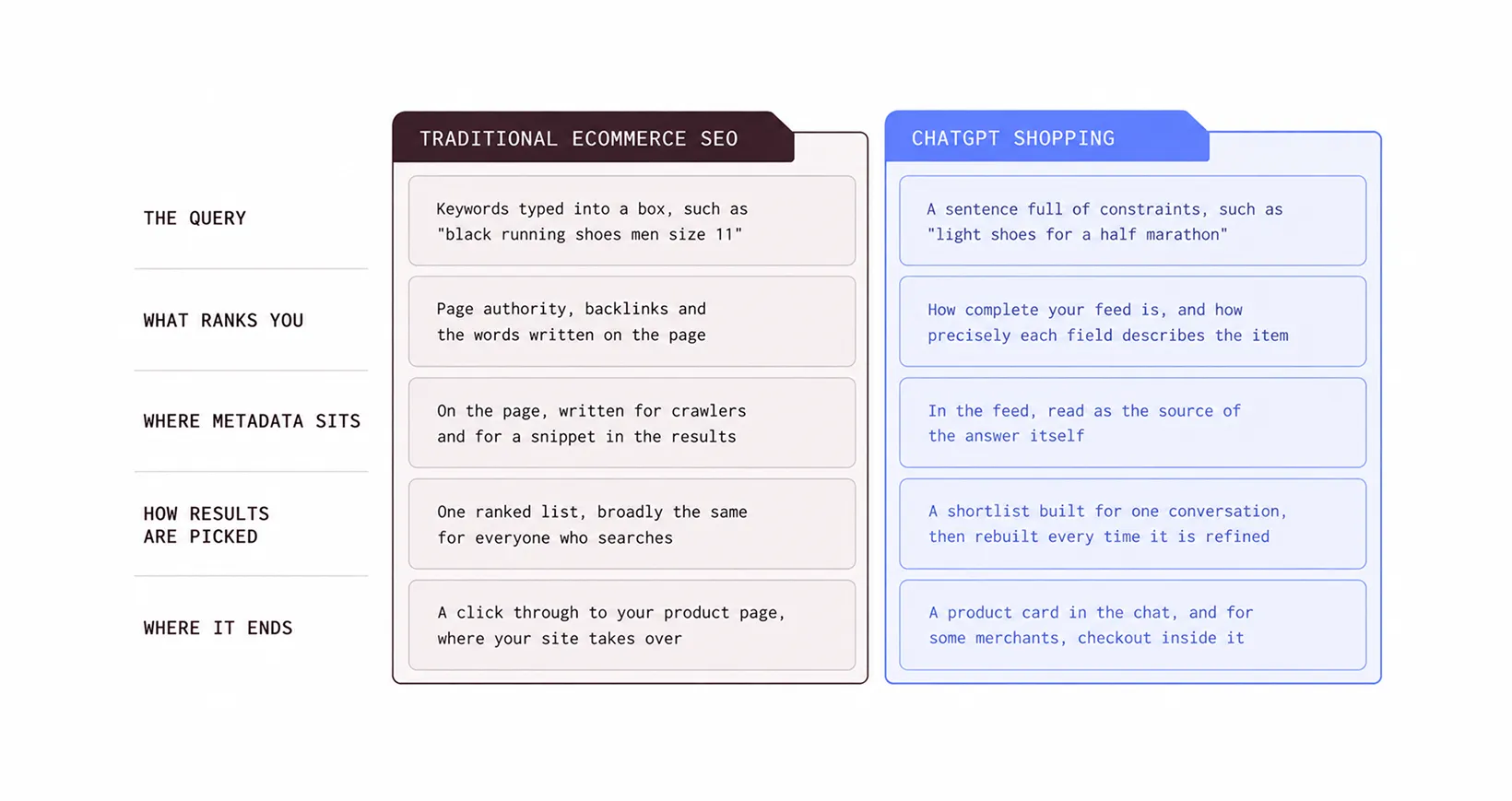
Keywords behave differently too. In search, a keyword is a target you rank against. In a conversation, the equivalent unit is an attribute. Filling in material isn't a keyword play; it's giving ChatGPT information it can use when material matters to the shopper.
Stale data also costs more. A wrong price on a landing page is an annoyance. A wrong price in an AI recommendation is a broken promise made on your behalf, in a context where the shopper never even reached your site.
The two disciplines aren't mutually exclusive, though. This is the part people miss. ChatGPT reads public retail pages, so your PDP copy still does work. The shift isn't from SEO to feeds. It's that structured product data now plays a bigger role because it is the part you can control most precisely.
A 30-day plan for preparing your catalog for AI shopping
You do not need to overhaul your entire catalog at once. Start with a focused set of products, fix the underlying data, and use what you learn to expand the work across the catalog.
Week 1: Audit your catalog
Start by understanding what you already have.
- Check that your product feed is active and that eligible products are available to ChatGPT through your current integration.
- Audit your highest-revenue or highest-priority SKUs.
- Identify missing or inconsistent attributes.
- Check titles, descriptions, variants, pricing, availability, images, ratings, and reviews.
- Look for important product information that exists on your website but is missing from the feed.
The output should be a list of specific data gaps, not a general assessment of your catalog.
Week 2: Improve product information
Focus on the products and attributes that matter most.
- Rewrite unclear or overly generic titles and descriptions.
- Add missing product attributes.
- Make important use cases and product characteristics explicit.
- Make sure reviews and ratings are available where supported.
- Standardize inconsistent information across products.
Start with your top 50 to 100 products rather than trying to rewrite thousands of SKUs at once.
Week 3: Test against real shopping queries
Now test whether the improved information actually helps.
Create a set of prompts based on how your customers shop. Include questions around price, use case, product characteristics, comparisons, and specific requirements.
For each prompt, record:
- Which products appear
- Which competitors appear
- Whether your product information is accurate
- What information appears to be missing
- Where your product seems less competitive
This gives you a practical feedback loop instead of relying on assumptions about how AI interprets your catalog. Treat these tests as directional rather than as a traditional rank tracker. Results can vary based on the shopper's context, preferences, and the product information available at the time.
Week 4: Scale what worked
Use the findings from the first three weeks to decide what should happen across the rest of your catalog.
If you found that certain attributes were consistently missing, fix them at the category level. If your titles were too generic, establish a better title structure. If important product information was buried in descriptions, standardize how it is presented.
This is also where a feed management platform such as Marpipe can become useful. Once you know what needs to change, you need a way to apply those changes consistently across a large catalog.
Structure your product feed so you can optimize it at scale with Marpipe
As you identify new product attributes, customer language, and gaps in your catalog, you need a practical way to apply those changes across your feed.
This becomes difficult when you have hundreds or thousands of SKUs. Manually updating individual products is slow and makes it harder to keep your catalog consistent.
Marpipe's feed management can help you manage these changes at scale. It lets you clean and standardize product data, modify fields, create categories and tags, and build product sets from your catalog. You can push the cleaned feed to Meta, Google, TikTok, Pinterest, Reddit, and Snapchat from one place.
That makes the workflow more practical. You can identify what shoppers need, improve your product data, apply those changes across the catalog, and distribute the updated feed. Try Marpipe for free and start managing and improving your product data at scale.
Frequently asked questions
Do I need a ChatGPT Shopping optimization tool?
No. If you already have a product feed, you can start by improving the data you have. A feed management platform becomes more useful when you need to make consistent changes across a large catalog or multiple channels.
Do I need a separate product feed for ChatGPT Shopping?
Not necessarily. It depends on how your ecommerce platform and existing feed setup connect with ChatGPT. Before building a new feed, check whether your current integration already provides complete, accurate, and current product data.
Does paying for ChatGPT ads improve organic product rankings?
No. Paid ads and organic product recommendations are separate. Buying an ad or enabling Instant Checkout does not automatically improve organic visibility. For organic discovery, focus on relevance, accurate product data, supporting evidence, and merchant quality.
Does ChatGPT Shopping replace Google Shopping?
No. They are complementary discovery channels. Google Shopping is built around traditional product search, while ChatGPT is useful when shoppers want help comparing options, narrowing choices, or describing a more specific need.
Can ChatGPT understand product information hidden in images?
It can use images, but you should not rely on them for critical product information. Important attributes such as size, material, compatibility, or specifications should also appear in structured or textual product data.