

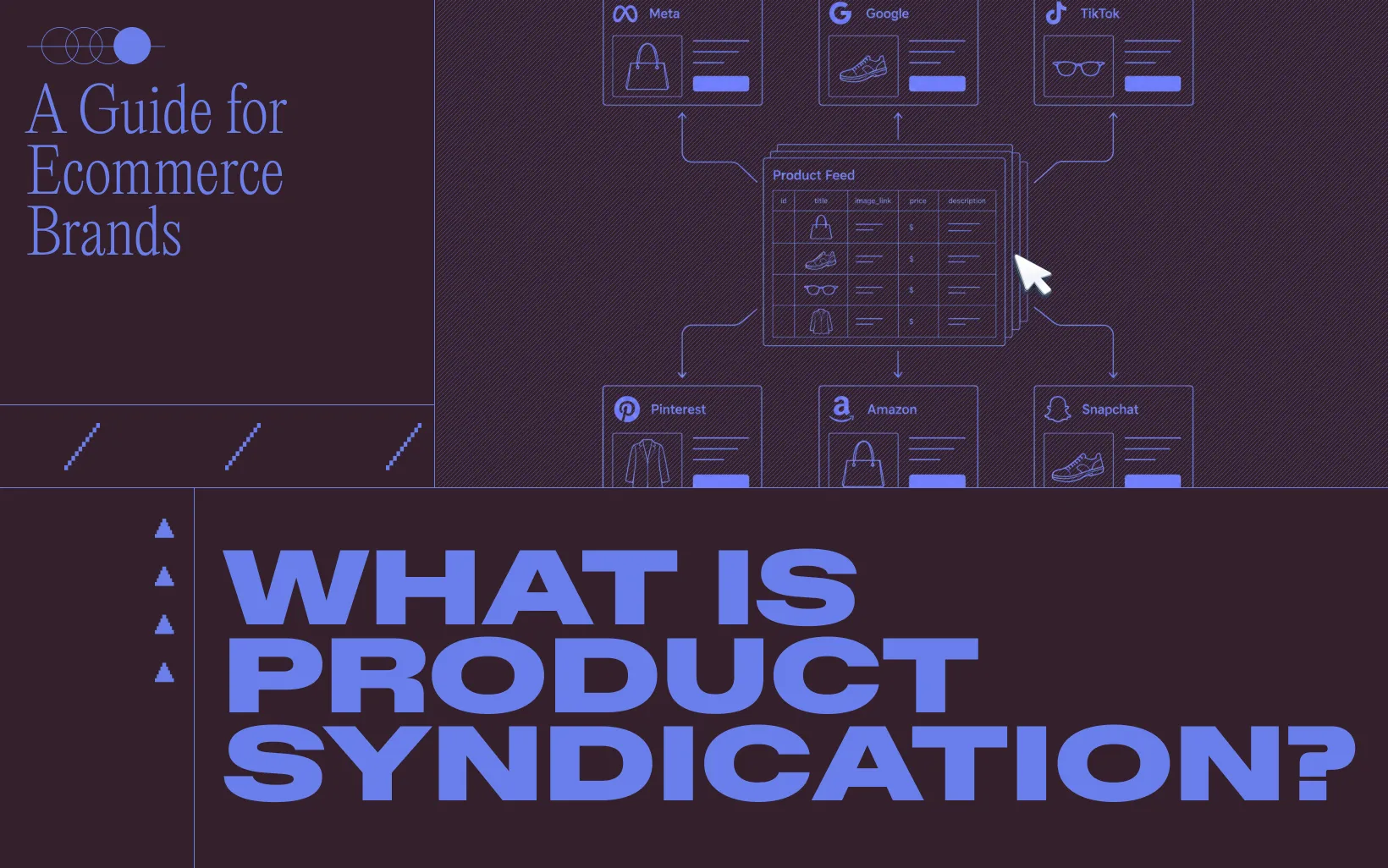
Product syndication is the process of distributing product data to the marketplaces and channels where your products are sold. Each destination has different requirements, so the same product data needs to be mapped and formatted differently for Amazon, Walmart, Google, Meta, and other platforms.
This guide covers how product syndication works, how it differs from product feeds and PIMs, what content can be syndicated, how data reaches retailers and marketplaces, and which tools manage the process. It also explains how syndication affects product discovery, conversions, and catalog advertising.
What is product syndication?
Product syndication or Product data syndication (PDS) is the process of distributing your product data (titles, images, prices, descriptions, and inventory) from a central source to multiple external channels at once, such as marketplaces, ad platforms, comparison shopping engines, and retail partners. Instead of manually uploading listings to each destination, ecommerce brands maintain one clean product feed and syndicate it out, keeping details consistent and up to date everywhere.
Here is what syndication actually involves
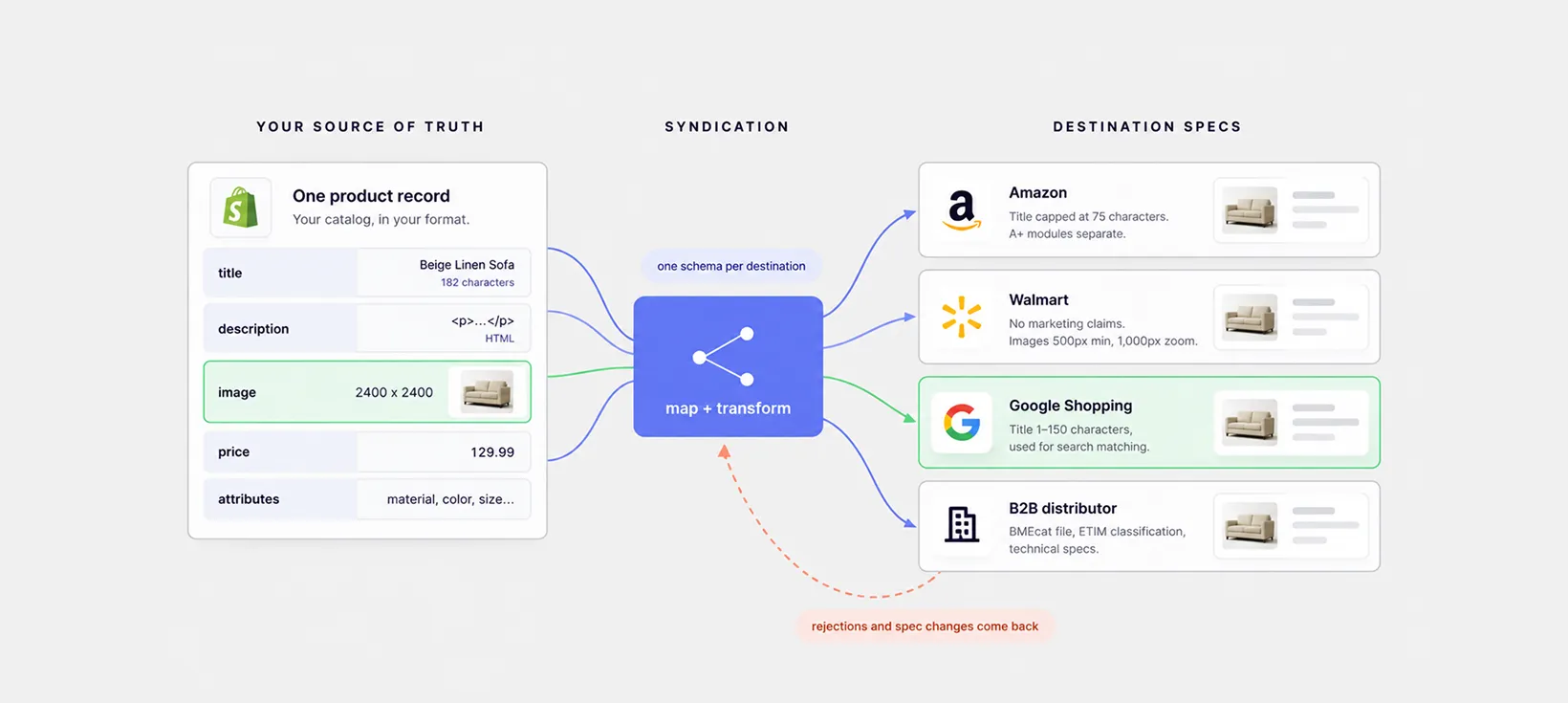
- Mapping: Your internal attribute names have to be matched to each destination's schema. Your colour_family becomes Amazon's color_name, Walmart's color, and Google's color.
- Transforming: Values get reformatted to fit. A 180-character title gets rewritten to 75 for Amazon. HTML gets stripped out of descriptions where plain text is required.
- Delivering: The content moves through whichever channel the destination supports — a spreadsheet template, an API, or a certified data pool.
- Maintaining: Rejections come back, specs change, prices move, items go out of stock. Syndication is the loop, not the launch.
How is product syndication different from a product feed?
A product feed is a file. Syndication is what you do with it, and what happens to it on the way when details are sent to different platforms.
The feed is a structured export of your catalog: one row per product, one column per attribute, delivered as CSV, XML, or through an API. Syndication is the process that takes that file, reshapes it per destination, delivers it, and handles what comes back.
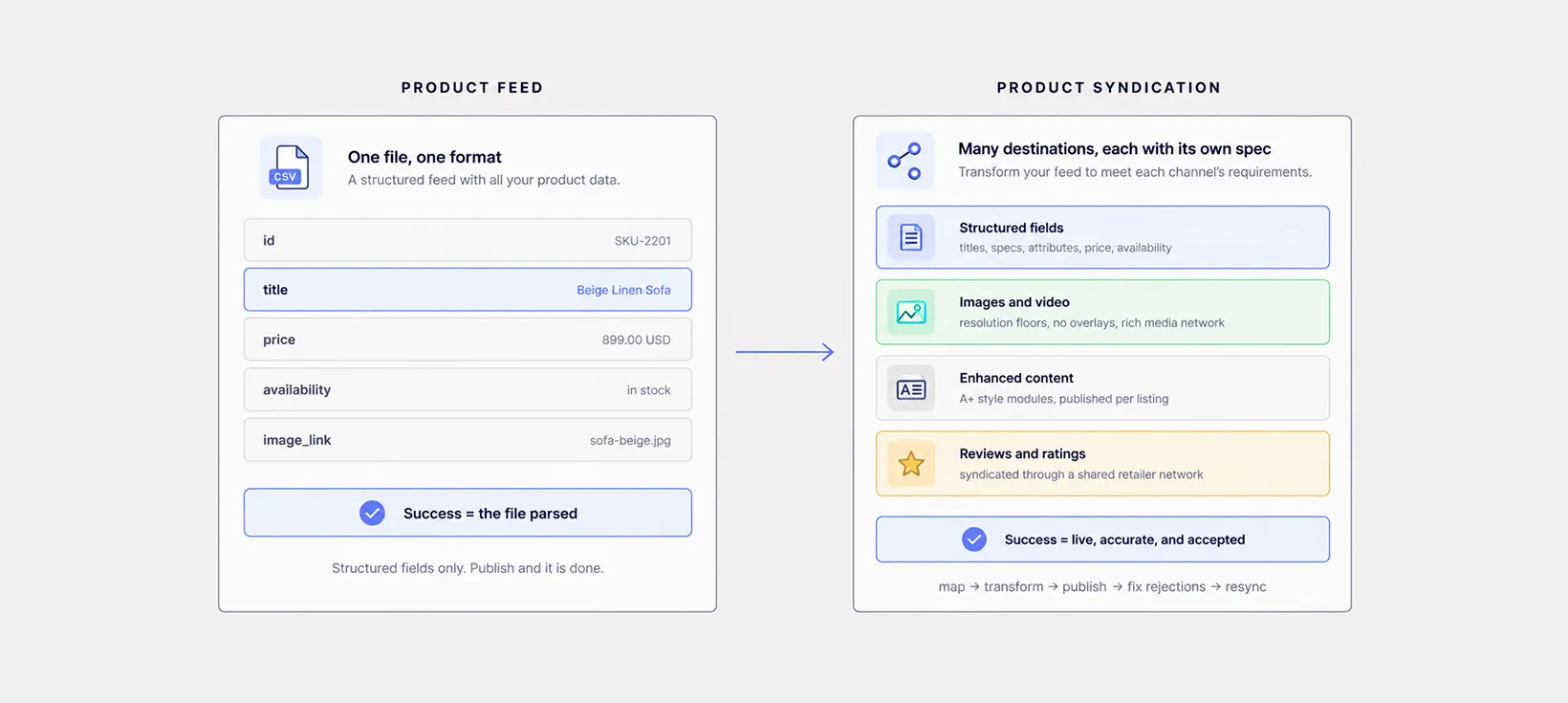
Three differences worth noting:
Google, Meta, TikTok, and Pinterest build their catalog ad listings entirely from a structured file, the product feed. So when you clean up your feed data, that work "pays off twice": once for your retail marketplace listings, and again for your ad platforms, because both are reading from the same well-organized source.
What content actually gets syndicated?
Syndicated content splits into three groups that travel differently, are owned by different teams, and fail in different ways. Treating them as one pipeline is the most common structural mistake in a syndication program.
Titles, specs, and structured attributes
This is the layer retailers use to categorize, filter, and match your product to a search. It is also the layer with the strictest limits.
If your syndicated title exceeds the limit, Amazon's system rewrites it for you. The rewrite is grammatically fine while dropping the keywords you were ranking for. Brand owners get a 14-day window to review, modify, or approve AI-generated recommendations. Sellers can still edit their titles and Item Highlights at any time.
Structured attributes are the half that decides whether you appear in filtered navigation at all. Color, material, size, dimensions, GTIN, brand, and category-specific attributes are what power "show me stainless steel, under $200, in stock." A product missing the attribute is not just ranked lower for that filter. It is absent from it.
Images, video, and rich media
Every destination has a resolution floor and a list of things it will not accept in the frame.
- Walmart requires at least one image side of 500 pixels or greater, and 1,000 or greater for zoom.
- Meta recommends at least 500x500 and rejects text overlays, watermarks, and borders.
Video and 3D assets are treated differently. Instead of referencing a file from a feed column, most brands distribute them through a rich media provider that hosts the asset and embeds a player directly on the retailer's product page.
The constraint is production rather than distribution. Someone has to make a video for each SKU first, which is why coverage usually stops at the top sellers.
Reviews and ratings
Reviews syndicate too, and they are the one content type you cannot simply author. Review syndication moves a review written on your own site or on one retailer's into the product pages of retailers in a shared network. Review count is a scored input, not just a persuasion asset. Walmart's Listing Quality Dashboard evaluates ratings and reviews as one of its named components, alongside content and discoverability and the offer itself.

How does product syndication work across retailers and marketplaces?
There are three technical routes content takes to a retailer, and most brands of any size use all three at once for different destinations.
1. Templated exports
The retailer publishes a spreadsheet template listing required and optional attributes. Your syndication software populates it from mapped data and you submit it. This is the most common route and the most brittle because templates change, and nothing tells you except a rejection.
2. Direct connections
Technically mature retailers expose APIs. Content posts straight to the endpoint, schema updates arrive automatically, and validation feedback comes back usable rather than as a failed upload. This is where Walmart's approach is instructive. Its Connected Content Partner program exists specifically to let suppliers hand item setup and content delivery to approved third parties.
3. GDSN data pools
For grocery, CPG, hardlines, and anything with a GTIN and a supply chain, data moves through the Global Data Synchronisation Network.
Publishing requires a GDSN-certified data pool, which registers your items in the GS1 Global Registry; retailers subscribe and receive updates continuously. GDSN carries logistics and compliance data well (dimensions, weights, packaging hierarchy, allergens) and marketing content much less so, which is why it sits alongside another route rather than replacing it.
Whichever route a destination uses, the loop is the same: map, transform, publish, read the rejections, resync. And this happens on every price and stock change, and again whenever the spec moves.
Why product syndication quality matters
The shopper does not experience your channels separately, and neither does the algorithm ranking you inside them.
Salsify's 2026 consumer research, a survey of 2,712 shoppers across the US, Canada, and the UK, found that 45% had returned an online purchase because of incorrect or misleading information, and that up to 45% of Gen Z and 43% of millennials abandon purchases when product details do not match across sites.
The company's prior-year research put a finer point on the same behavior, with inconsistent product information across websites (54%) ranking as the single most common reason shoppers abandon a purchase, ahead of incomplete titles and descriptions (53%), missing reviews (48%), weak brand trust (45%), and poor or absent images and video (42%).
The mechanism is simply that shoppers cross-check. A dimension that reads 24 inches on your site and 61 centimetres rounded wrong at a retailer is not a data hygiene issue, it is a reason to close the tab.
Then there is the platform layer, where content quality is scored explicitly:
- Search and ranking. Google states that the title "will be used to match your product to a customer's search." A title written for your own PDP, where brand-first naming is fine, underperforms where the shopper typed "insulated stainless water bottle 32oz."
- Listing quality scores. Walmart's dashboard grades content and discoverability (item name, description, key features, images) as a distinct component, and states outright that the categories are "not equally evaluated."
- Enhanced content. Amazon states that Basic A+ Content can increase sales by up to 8% and well-implemented Premium A+ Content up to 20%. That content is produced and published per listing, outside the feed.
- Ad eligibility. On the paid side the same fields become gating criteria. Meta requires id, title, description, availability, condition, price, link, image_link, and brand, and the price must match the landing page. A mismatch is not a soft signal — the item drops out.
This is why feed-quality work and ad-performance work stop being separate projects. Every disapproved item is a product your budget cannot reach, and every stale price is either a rejection or a bad click you paid for. Getting the catalog clean sits upstream of every performance lever you have.
What tools handle product content syndication?
Product content syndication software clusters into 5 categories.
Before you choose any tool, ask these 2 questions:
- Where does your content break? Is it at the schema, or at the destination? If your attributes are inconsistent internally, a syndication network will faithfully distribute the inconsistency. That is a PIM problem first.
- How often do your destinations change? Grocery and hardline retailers on GDSN change slowly. Marketplaces and ad platforms change constantly. Tools built for the first are usually painful for the second, and vice versa.
For the advertising destinations, you can choose a feed management tool. Marpipe's Feed Management is free with no limits or expiration, cleans and standardizes product data, and pushes the same catalog to Meta, Google, TikTok, Pinterest, Reddit, and Snapchat from one place. If your stack is enterprise-grade on the retail side and duct tape on the ad side, that gap is now cheap to close.
How does product syndication connect to catalog advertising?
Ad platforms are syndication destinations too, and catalog ads are assembled from the exact fields you syndicate.
When Meta serves a catalog ad, image_link becomes the ad image, title becomes the headline, price becomes the price, and link becomes the destination. Nothing in that ad was designed after the feed was written — so the decisions you made for marketplace compliance are now making creative decisions in your ad account.
That's a problem, because the two jobs pull in opposite directions. Marketplace rules push you toward bare product-on-white with no overlays or borders, which is right for an Amazon listing and weak in a paid social feed. A 75-character Amazon-compliant title reads as a spec string in an ad headline.
So the sequence that works is layered:
- Syndicate compliant content everywhere: Clean attributes, accurate prices, real availability, per-destination formatting.
- Design on top of it for the ad destinations: Take the same feed and apply designed catalog creative such as brand templates, price and discount treatments, lifestyle context, video, for the placements where an ad has to win attention.
Use your clean product feed to build catalog ads worth clicking
Product syndication gets your content compliant everywhere. It doesn't make it perform. Marpipe is the creative layer on top of the feed you've already cleaned. It connects to the same catalog you syndicate to Meta, Google, TikTok, Pinterest, and Snapchat, then applies designed templates across every SKU.
Here's what that adds to a catalog you've already syndicated:
- Design control over every SKU: One dynamic template pulls text, images, prices, and descriptions from your feed and generates a brand-consistent ad for every product in the catalog.
- Conditional logic per segment: Design rules keyed to category, price tier, or inventory status, so a clearance item and a full-price hero get different layouts from the same template.
- Offer signals in the creative: Price strikethrough, percentage off, countdown clocks, inventory scarcity, and realtime social proof, applied dynamically across the catalog.
Book a demo and we will build mockups from your actual catalog, so you can judge the creative on your own products and see how it'll help you improve conversion.
FAQs
What is product data syndication?
Product data syndication is the distribution of structured product attributes — identifiers, titles, specifications, pricing, availability — to retailers, marketplaces, distributors, and ad platforms in each destination's required format. It is the same discipline as product content syndication, with the emphasis on structured fields rather than marketing copy, imagery, and reviews.
What is the difference between product syndication and a PIM?
A PIM is where product information lives; syndication is how it leaves. The PIM enforces internal consistency and completeness. Syndication maps and transforms that content per destination and delivers it. Some platforms do both, but the failure modes are separate: bad data in the PIM gets syndicated faithfully and breaks everywhere at once.
How does Amazon product content syndication work?
Content reaches Amazon through Seller or Vendor Central feeds and APIs, or through a syndication vendor that maintains those integrations. Two constraints shape the work: titles are capped at 75 characters, with over-limit titles rewritten automatically, and enhanced content (A+ Content modules) is published separately from the feed. Amazon states Basic A+ can increase sales by up to 8% and Premium A+ up to 20%.
How does Walmart product content syndication work?
Suppliers either manage items directly in Supplier One or authorize a Connected Content Partner by sharing a Consumer ID and Private Key, after which the partner handles item setup and content updates. Walmart scores the result in its Listing Quality Dashboard across content and discoverability, offer, and ratings and reviews, and applies content rules including a 500-pixel minimum on at least one image side, 1,000 pixels or more for zoom, and no marketing claims in item names.
What is product video syndication?
Distributing product video to the retailer pages where your items are sold, usually through a rich media provider that hosts the asset and embeds a player on the retailer's PDP rather than referencing it from a feed field. The limiting factor is production: most catalogs have video for a small subset of SKUs, which is why generating per-SKU video from existing product images has become the practical route to full coverage.
How often should syndicated product content be updated?
Price and availability need to move as close to real time as each destination allows, because both are enforced. Content and attributes need a review cycle tied to your catalog changes and each destination's spec updates. Realistically: continuous for commerce data, quarterly for content audits, plus an unscheduled pass whenever a retailer revises its template.
Does syndicated content affect SEO?
On the retailer's site, yes. Content quality and completeness feed its search ranking and filtered navigation, which is where most marketplace discovery happens. On your own site, syndication does not help directly, and duplicating identical descriptions everywhere means the retailer's page, not yours, tends to win the search result for your product name.