

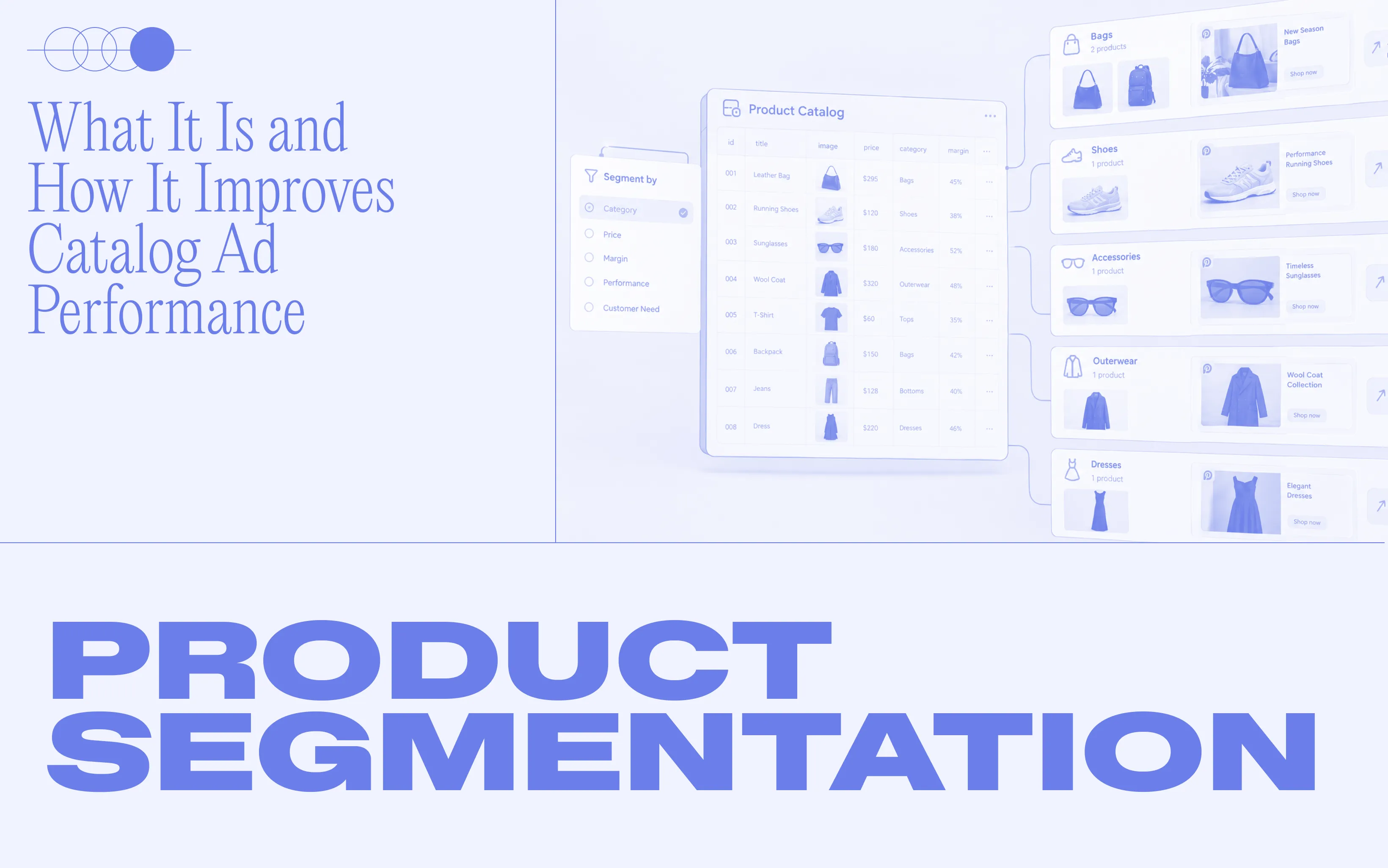
Product segmentation is the practice of splitting a product catalog into smaller groups based on shared traits, such as category, price, margin, performance, or the customer need each product solves. Instead of treating every SKU the same, you treat each segment according to what actually applies to it. For a catalog with a few hundred SKUs or a few hundred thousand, segmentation is what makes the catalog manageable, and it's what makes catalog ads perform.
If you run catalog ads on any platform (Meta DPA or Advantage+, Google Shopping, TikTok DPA), product segmentation solves a visual problem you've likely already noticed. A default catalog campaign treats a $20 phone case and a $400 jacket with the same layout, badges, and design logic. Segmentation is how you stop treating unrelated products identically. This article covers what product segmentation means, how it differs from market and customer segmentation, the main ways to split a catalog, and how to build a segmentation strategy that actually changes your advertising performance.
What is product segmentation?
Product segmentation groups the items in a catalog by shared characteristics so you can apply different rules, designs, or bids to each group. A segment can be as broad as "apparel" or as narrow as "SKUs under $15 with fewer than 10 units in stock." The primary goal is that everything inside a segment gets treated consistently, while products outside that segment can receive different treatment.
Common segmentation dimensions include:
- Category or subcategory (jackets, mugs, skincare serums)
- Price or margin tier (budget, mid, premium; high-margin versus low-margin)
- Performance or velocity (bestsellers, steady sellers, slow movers)
- Inventory status (in stock, low stock, out of stock, new arrival)
- Audience or use case (gift-buyers, replenishment shoppers, first-time buyers)
Most catalogs benefit from using more than one of these dimensions at once. A single SKU can sit in a category segment, a price segment, and a performance segment simultaneously, and each dimension can drive a different decision in your advertising account.
How is product segmentation different from market or customer segmentation?
Market segmentation splits your total addressable market into groups by region, industry, or firmographics. Customer segmentation splits the people who already buy from you by behavior, lifetime value, or purchase history. Product segmentation splits neither of those. It splits your catalog itself, based on traits the products have, not traits the people buying them have.
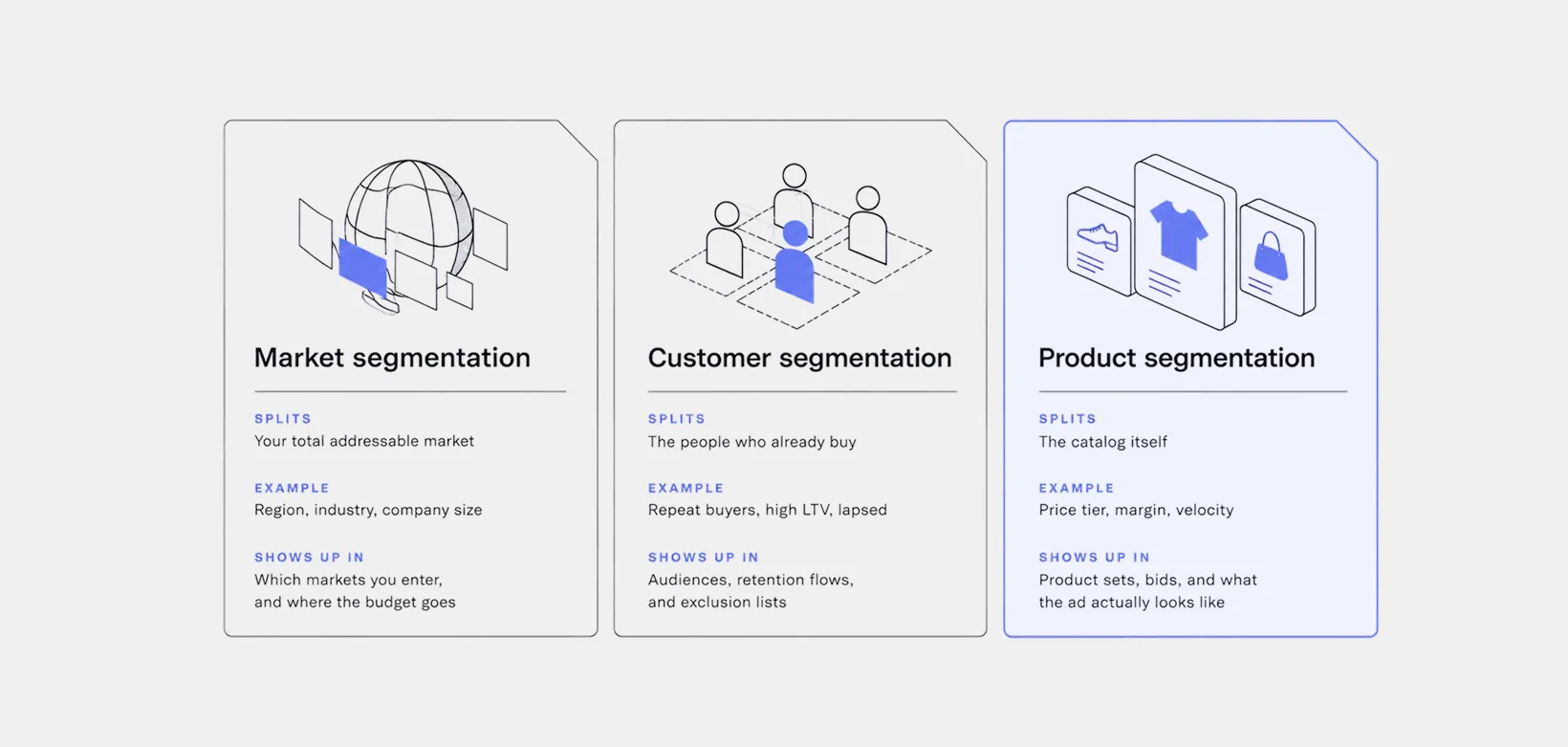
These three segmentation approaches are not competitors. In a mature marketing setup they work together. You might target a customer segment (repeat buyers) with a product segment (your premium tier) using creative built specifically for that pairing. But product segmentation is the one most DTC brands with large catalogs skip, because it feels like a merchandising task rather than a marketing one. It isn't. Your product feed is the input to every catalog ad you run, and an unsegmented feed means every product gets the same ad treatment regardless of what it is, what it costs, or how well it's selling.
What are the main ways to segment a product catalog?
There's no single correct way to segment a catalog. Many performance marketers combine two or three of the dimensions below, layering them until the segments map to a real decision like a design change, a bid change, or a budget shift. Start with whichever dimension your feed data already supports cleanly.
By performance or SKU velocity
This segmentation dimension has the most direct line to return on ad spend. Split products by how they're actually performing in terms of sales velocity:
- Bestsellers have high volume and proven demand. Protect their budget and give them your best creative treatments.
- Steady sellers deliver consistent but unremarkable performance. These are good candidates for testing new creative designs, since a loss here is low-risk.
- Slow movers show low volume with high spend relative to return. Either cut spend, discount aggressively, or pull them from the catalog feed entirely.
- New arrivals have no performance history yet. Treat them separately until they have accumulated enough data to move into one of the other tiers.
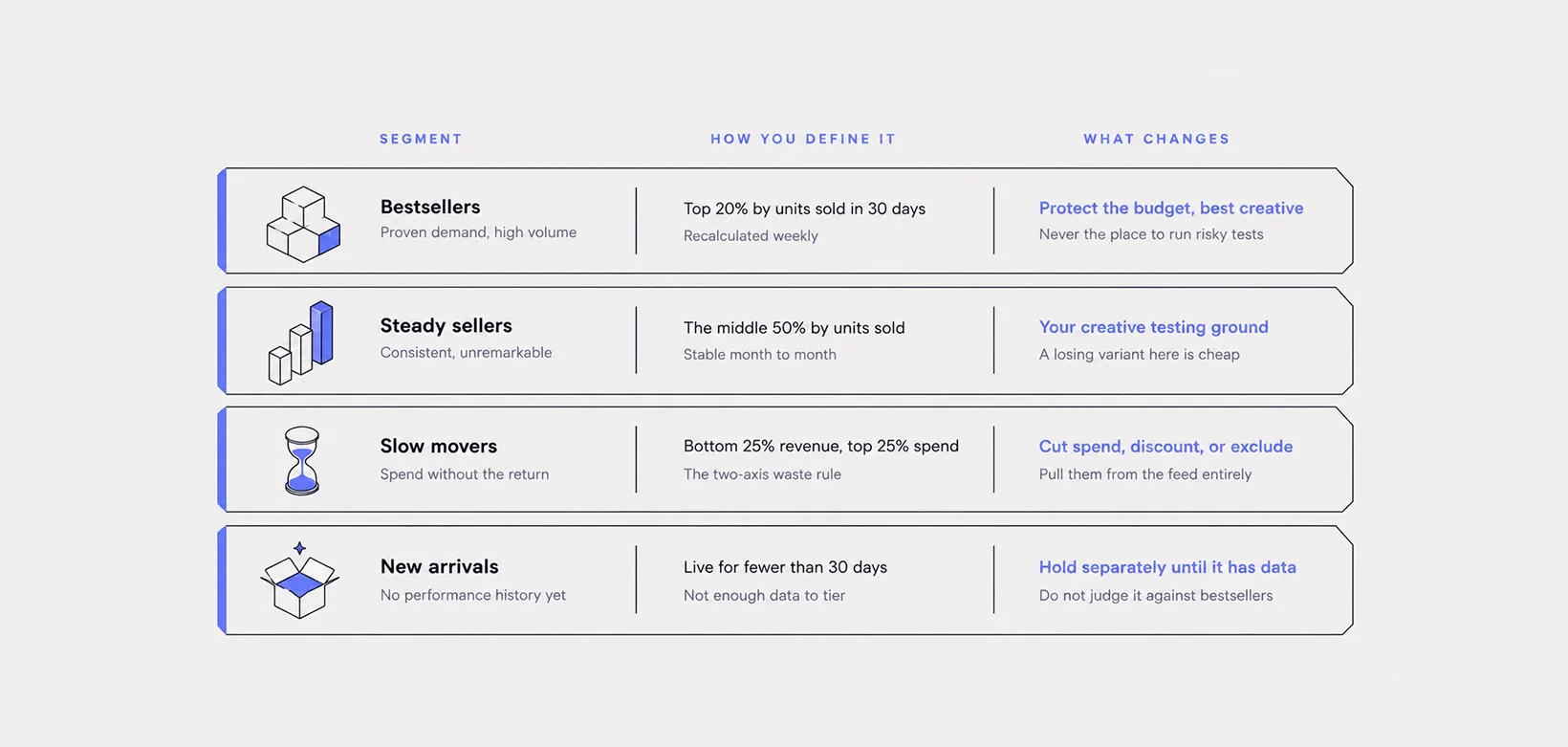
Velocity segments should update on a refresh schedule, not just once. Sales patterns shift over time. A bestseller in July can become a slow mover in November as seasonality changes or customer preferences evolve. This is why automating segment updates is valuable.
By category or attribute
Category segmentation is the most straightforward approach: apparel, footwear, home goods, accessories. Attribute segmentation goes a level deeper, using any field in your feed (material, color, size, gender, collection) to build narrower sets. A footwear brand might segment by category (sneakers versus boots) and by attribute (waterproof versus not) at the same time, then design each combination differently.
If you don't have a paid creative platform yet, you can still start building these segments today. Marpipe's free Feed Management tool includes a Create Categories & Tags feature built for exactly this:
- Build product sets from any combination of feed attributes
- Apply labels and tags to segment your catalog for better targeting
- Push the segmented feed to Meta, Google, TikTok, Pinterest, and Snapchat from one place
This is a practical starting point for segmenting a catalog before committing to a dedicated creative platform.
By margin or price tier
Price and margin segmentation exist because a 40 percent lift in clicks on a low-margin SKU can be worth less financially than a 5 percent lift on a high-margin one. Group products into tiers, for example budget, mid, and premium, or simply high-margin versus low-margin. Let that tier decide two things: how much you are willing to spend to acquire a customer for that product, and what the ad creative emphasizes. A premium tier can afford to lead with brand and quality. A budget tier usually needs to lead with price and value, since that is what the buyer is optimizing for.
By audience or use case
Not every product sells to the same shopper for the same reason. A kitchen brand might have one segment for everyday cookware bought by existing customers restocking, and a separate segment for gift-set bundles bought by new customers around the holidays. The product data doesn't always spell this out clearly. It usually comes from combining category or collection tags with what you already know about purchase patterns, then building the segment around the use case rather than the product type alone.
How does product segmentation improve catalog ad performance?
Meta's automated systems (Advantage+ Shopping, DPA) decide who sees an ad and when. They don't decide what the ad looks like or what it says. That is still entirely up to the creative you feed them. An unsegmented catalog forces every product through the same design, the same messaging, and often the same bid strategy, regardless of whether that approach fits the product.
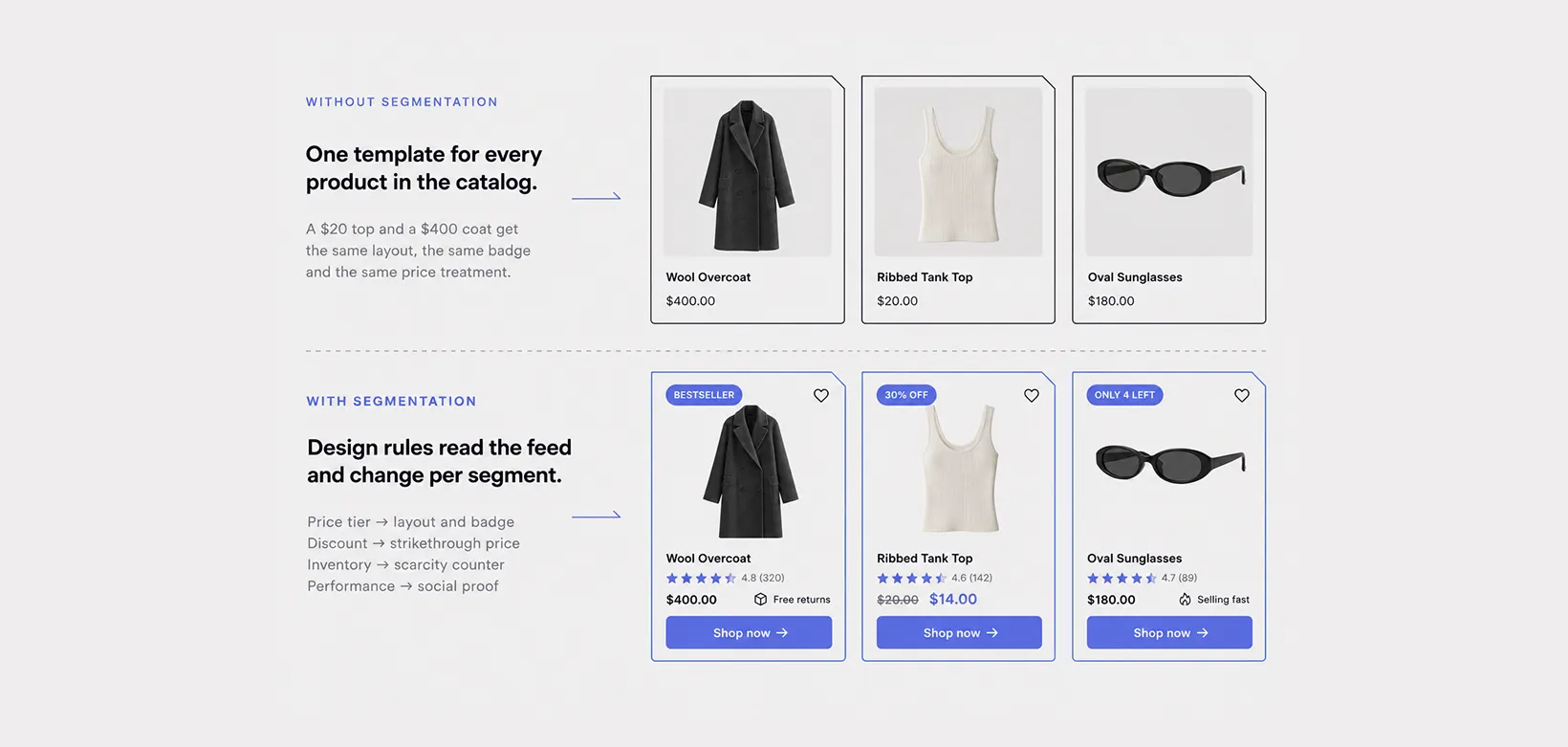
Segmentation fixes this at the source with three direct improvements:
- Spend follows performance. Velocity segments let you protect budget on bestsellers and cut it from slow movers, instead of spreading spend evenly across a catalog where half the SKUs were never going to convert at an acceptable rate.
- Creative matches the product. A premium-tier segment and a clearance segment shouldn't look the same. Segmenting by price or category lets you apply a design rule (a badge, a layout, a message) that fits the group instead of using a one-size-fits-all template.
- Testing gets sharper. Instead of testing one creative variant across an entire catalog, you can test variants within a segment and learn faster, because you're comparing like against like.
The brands that treat their catalog ads as one undifferentiated block are usually the ones stuck with the default look: a bare product photo on a white background with a price underneath. Segmentation is the first step toward giving each product group a design that actually fits it.
How do you build a product segmentation strategy?
Start smaller than you think you need to. A strategy with two clean segments beats one with ten segments nobody maintains.
- Audit your feed data first: Segmentation is only as good as the fields available in your product feed. Check what data you actually have (price, category, inventory, sales history) before designing segments around data you wish you had.
- Pick one primary dimension: Performance, category, or price tier are the easiest starting points because most feeds already carry that data cleanly.
- Define the segments in writing: "Bestseller" needs a threshold (top 20 percent by units sold in 30 days), not a vague feeling. Vague segment definitions fall apart the first time someone else has to maintain them.
- Decide what changes per segment: A segment only matters if something downstream changes because of it: a design, a bid, a budget cap, an inclusion or exclusion rule.
- Automate the update cycle: Manually re-tagging a catalog every week doesn't scale. Set a refresh cadence (weekly is common for velocity segments, monthly for category or price tiers) and tie it to your feed sync.
- Layer a second dimension once the first is stable: Category plus price tier, or velocity plus margin, is where most mature segmentation strategies land. Don't start there.
How do you act on your segments once they're built?
A segment only earns its keep when something downstream changes because of it. In practice there are only two things that can change: how much you spend on a segment, and what the ads for that segment look like. Most brands get partway through the first and never touch the second.
Cutting spend on the segments that lose money
Your velocity segmentation identifies slow movers. Acting on it means excluding them from the feed every week as the list shifts — and that maintenance is what kills most segmentation strategies. The segments are accurate in month one and stale by month three.
Marpipe's SKU Optimization automates that half with pre-built filters you can point at a threshold instead of a feeling:
- Remove products in the bottom 30% of monthly sales
- Filter out products in the bottom 25% of revenue that are also in the top 25% of ad spend
- Remove products in the bottom 40% of CTR
- Filter out products with high return rates
The second rule is the one worth copying whether or not you use a tool. Filtering on low revenue alone punishes cheap products that are doing fine; filtering on high spend alone punishes your bestsellers. The intersection isolates the genuinely pathological SKUs — expensive to advertise and not selling. The return-rate filter is the most under-used of the four, because return data lives in a different system than your ad platform, so a product with strong ROAS and a 40% return rate looks like a winner on every dashboard you check.
Designing each segment differently
This is the half Meta doesn't solve. Its native customization stops at a fixed menu of generic badges and frames, so a bestseller and a clearance SKU still get pulled through the same treatment no matter how carefully you've segmented upstream.
Marpipe's Catalog Creative is a drag-and-drop template builder where the design itself responds to the feed:
- If/then design rules — "show a sale badge if the discount is over 20%," "swap the layout if the product is in the premium tier"
- Category-specific templates inside one design system, so a premium SKU and a clearance SKU come out of the same template looking genuinely different
- Unlimited creative variants tested across segments at once, so a design that wins for footwear doesn't get assumed to win for accessories
DermStreet cut CPA by 30% using price overlays, which is a price-tier segmentation decision expressed as a design rule. Ashley Canada saw a 33% lift in purchase ROAS from AI-generated catalog ads. Across Marpipe's case study library, ROAS lifts cluster in the +30–60% range.
Book a demo to see how Marpipe helps improve your catalog ad conversions once every segment stops sharing the same design.
FAQs
What is the difference between product segmentation and market segmentation?
Market segmentation splits your total addressable market by region, industry, or firmographics. It's about who could buy from you. Product segmentation splits your catalog itself, by traits like category, price, or performance. It's about what you're selling, not who's buying it.
How many segments should a product catalog have?
Start with two or three, built around one dimension like performance or category. Add a second dimension only after the first is stable and someone is actually maintaining it. More segments than your team can update regularly become a liability, not an advantage.
What data do I need to segment my catalog?
At minimum, your product feed needs consistent category tags, price fields, and enough sales history to calculate velocity. Inventory status and margin data help but aren't required to start. Audit what is already clean in your feed before designing segments around data you don't have.
Can small catalogs benefit from product segmentation?
Yes, though the payoff scales with catalog size. Even a few hundred SKUs benefit from separating bestsellers from slow movers, since spend efficiency improves either way. The larger the catalog, the more segmentation matters, because manual, product-by-product decisions stop being possible.
How often should product segments be updated?
It depends on the dimension. Velocity and inventory-based segments should refresh weekly, since sales patterns shift fast. Category and price-tier segments are more stable and can update monthly, or whenever the catalog itself changes.
Does product segmentation work with Meta Advantage+ campaigns?
Yes. Advantage+ still relies on the creative and feed data you provide, it just automates the delivery decisions (who sees what, and when). Segmentation determines what creative and structure Advantage+ has to work with, which directly affects how well its automation performs.
What is SKU velocity segmentation?
SKU velocity segmentation groups products by how fast they are selling, typically bestsellers, steady sellers, and slow movers. It's one of the most common segmentation dimensions because it maps directly to a spending decision: protect budget on what's working, cut or discount what isn't.