

Dynamic product ads were built for retargeting. Someone views a product, leaves, and that same product shows up in their feed until they buy. It works because the hardest part, knowing what to show, is already answered by what the person browsed.
Prospecting is a different situation. There's no browsing history, no abandoned cart, and no signal about which of your SKUs a new person might want. You're asking for a system designed to show people what they already looked at to instead find people who have never heard of you. When a lot of teams try it, they see ROAS drop well below their retargeting numbers, and decide catalog ads don't work for cold audiences.
They do work, but scaling DPA and catalog ads for prospecting takes a different setup, not just more budget on your existing one. This guide covers how to do it. We'll show you how to structure your catalog and audiences for discovery, and what creative cold traffic needs that retargeting doesn't.
1. Hand the targeting to Advantage+, and feed it the right way in
Catalog ads built their reputation on retargeting. Show someone the exact product they browsed, win the sale back. It works, but the audience is capped by definition since you can only retarget people who already found you.
Scaling means using the same catalog to reach people who have never heard of you. That comes down to how you set up the prospecting side.
First, know which engine you're running. There are two ways to do cold catalog prospecting, and they behave differently:
- Dynamic Ads for Broad Audiences (DABA): This is the older mechanism. You keep the campaign open and Meta serves products to people showing buying signals for that category, not just visitors to your site.
- Advantage+ Catalog Ads: It's the newer path. Lets you pick a broad audience or a retargeting audience right at setup.
- Advantage+ Shopping (ASC): It goes a step further and runs prospecting and retargeting together in one campaign, letting Meta decide the split for you.
Here's a quick rule of thumb on which to pick:
- Want a hands-off scale? ASC is the simplest.
- Want to keep prospecting and retargeting in separate campaigns so you can read the numbers cleanly? Run Advantage+ Catalog Ads with the broad audience option.

Then go broad with your targeting. Your instinct on a cold audience is to get precise: stack interests, build lookalikes off your buyer list, narrow the age range. For prospecting campaigns that work against you. Instead:
- Set the objective to Sales
- Leave age and gender open
- Keep the geo at country or region level
- Drop the interest and lookalike layers
Broad targeting used to be a gamble. But not anymore. Meta's models have absorbed enough purchase signal that broad plus a catalog now competes with a well-built lookalike, and it gives the algorithm far more room to find buyers you would never have picked by hand. Run it as a Carousel or Collection so Meta can pull several products into one ad and reshuffle which ones each person sees.
Set your expectations before you turn it on. These campaigns need volume to learn, so they reward accounts already doing real purchase counts:
- Under 50 purchases a week: stay on manual DPA against warm audiences for now.
- Comfortably above that: start broad catalog prospecting with 20 to 30 percent of your DPA budget rather than flipping everything over at once.
- ROAS target: cold prospecting usually lands around 1.5 to 2.5x once it exits the learning phase, lower than the 2 to 4x you see on retargeting. You're paying to introduce the brand, not to close someone who already knows it.
None of this fires, though, if the creative is weak. Broad Advantage+ controls who sees the ad and when, but a cold shopper still needs a reason to stop, and a bare product-on-white shot rarely gives them one. That reason lives in the feed itself, which is where point 2 picks up.
2. Make the feed do the converting, not just the catalog
When you let Meta pull from your product catalog, the default image is whatever sits in your product feed, which for most brands is a product floating on a white background. That might work for retargeting, where the person already wants your product. On a cold prospecting audience it disappears. Nobody who has never heard of you stops scrolling for a plain product shot.
So the real impact doesn't come from targeting. You need to make the product catalog itself stop the scroll. Custom feeds let you layer information onto every product image automatically, across thousands of SKUs at once, without designing a single ad by hand.
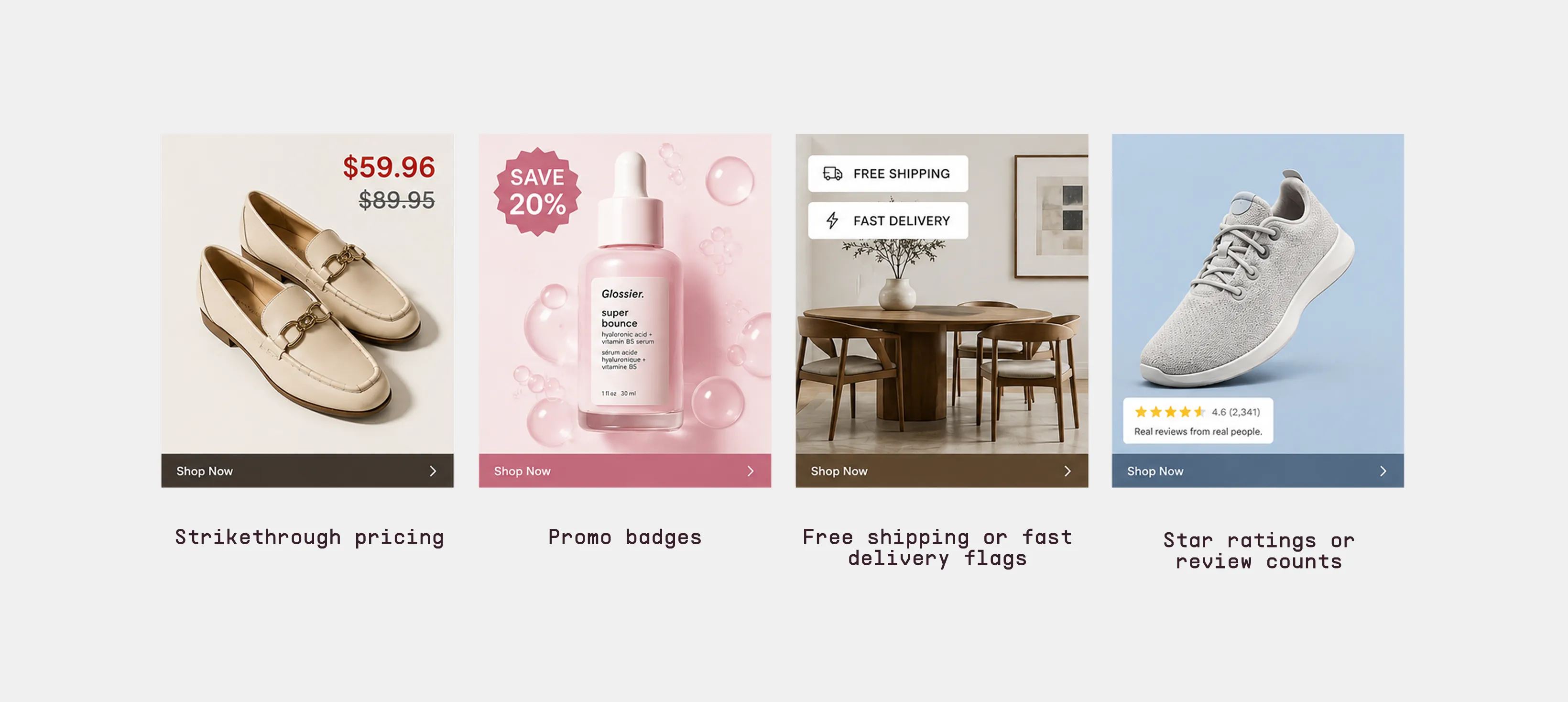
Here are the overlays worth testing:
- Strikethrough pricing that pulls the original and sale price from your feed and shows the drop on the image, calculated per product
- Promo badges like "Save 20%" or "Limited time" for the SKUs actually on offer
- Free shipping or fast delivery flags, which do a lot of quiet work on a first impression
- Star ratings or review counts, social proof that matters most when the buyer doesn't know you yet
Meta has a built-in overlay tool, and it covers the basics: price, strikethrough, percentage off, free shipping. You get Meta's fixed templates and not much design control. Tools like Marpipe help you go further, letting you build branded frames and templates and apply them across the whole catalog, so the ad looks like creative you made on purpose rather than a database row.
With Product Level Video (Meta calls it Dynamic Media) you upload video at the SKU level, so the same dynamic system that picks the product now picks a clip to go with it. If you feed in creator-style UGC, product-page videos, or hero-product cuts, you get into Reels placements.
Dynamic copy is another feature that helps you scale your ads. It uses feed parameters in your primary text, things like {{product.name}} and {{product.price}}, so the wording reshapes itself to whatever item is showing.
Broad Advantage+ decides which product reaches which person, and the enriched feed decides whether that person stops. Point 3 narrows the other variable, which products you let into the prospecting pool in the first place.
3. Scale the budget slowly, then scale sideways
Catalog prospecting gets bad conversions not by a bad setup but by an impatient one. The campaign starts working, you get excited, you double the budget, and performance falls apart. Catalog ads need time to learn, and the scaling has to respect that.
Let it learn before you touch it. Every new ad set sits in a learning phase while Meta figures out who to serve. It exits once it hits roughly 50 conversions a week. Until then the numbers are noisy and not worth reacting to.
- Give a fresh prospecting campaign a consistent budget for about 15 to 20 days to get there.
- Cutting budget early or editing the ad set mid-learning resets the clock and wastes what it already learned.
- If a set can't realistically reach ~50 weekly conversions, that's usually a sign the set is sliced too thin (back to point 3).
Scale vertically in small steps. Once a set is profitable and out of learning, you can add budget, but gently. The rule that works is:
- Raise the daily budget by 20 to 30 percent every few days, not overnight.
- Doubling a budget in one move re-triggers learning and tanks delivery. Gradual increases expand reach while keeping the optimization intact.
Automate the tedious part.
Instead of logging in to nudge budgets by hand, set automated rules in Ads Manager:
- Increase the daily budget by 15 to 20 percent when CPA stays below target over a rolling 7-day window.
- Alert you when an ad set drops into "Learning Limited," or when spend climbs without conversions, so you catch problems on day two instead of day seven.
Then scale sideways, because one ad set has a ceiling. Pump endless budget into a single ad set and you hit audience fatigue. The tell is frequency creeping above 3 and performance sliding even though nothing in the setup changed. Rather than push harder on a tired set, scale horizontally:
- Duplicate the winning ad set and point it at a slightly different broad group.
- Or keep the audience and feed in new creative, fresh frames, overlays, or a video angle from point 2.
- Build a small stable of winners running in parallel instead of one ad set you keep straining.
Vertical scaling grows what's working, horizontal scaling protects it from burning out. Used together, that's how catalog prospecting goes from a test line item to a real acquisition channel.
4. Don't hand Meta the whole catalog at once
If you sell more than a handful of products, dumping the entire catalog into one prospecting campaign lead to lower conversion. A cold audience has no history with you, so Meta is guessing which of your SKUs to lead with. Help it guess better by deciding what's even allowed in the pool.
The tool for this is the product set, built in Meta Commerce Manager. Think of it as the unit of segmentation:
- The campaign chooses between sets.
- The algorithm chooses within a set.
So the sets you build are the strategy. Here are the ones worth running for prospecting.
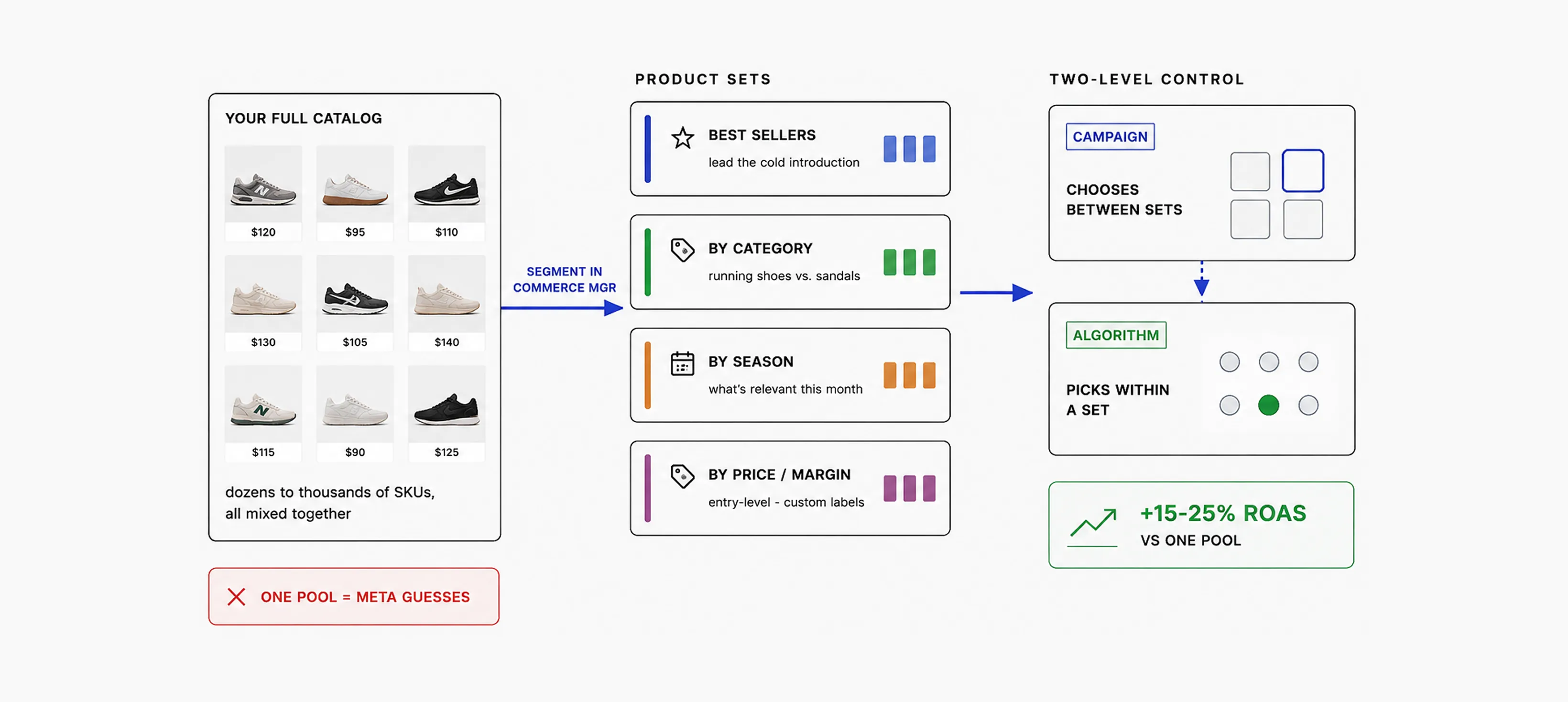
Put your best sellers first. Build a set of your top sellers and let that handle the cold introduction, instead of asking a brand-new shopper to discover your long tail. A product that already converts warm traffic tends to convert cold traffic too.
Build thematic sets. Group products by a shared angle so Meta can match a theme to an intent:
- Category (e.g. running shoes vs. sandals)
- Season (what's actually relevant this month)
- Price point (an entry-level set is a softer first ask than your premium line)
- Margin tier, tagged with custom labels in your feed, so you can lean into the products that are actually profitable to acquire on
This kind of segmentation isn't busywork. Splitting by category or margin often moves ROAS 15 to 25 percent versus running everything in one undifferentiated set, because the algorithm optimizes toward the items new buyers are most likely to click.
Teams used to build narrow sets of 20 to 50 SKUs specifically to force budget toward certain products. Meta's March 2026 update added SKU-level budget allocation, so Advantage+ can now distribute spend per product inside a set, not just per set. You can build broader sets and let the system allocate down to the SKU, instead of micro-managing tiny sets by hand. Still segment by theme and intent.
Choose Marpipe to make catalog ad prospecting actually work
Everything above comes back to one thing: prospecting puts the full weight on your creative. Retargeting can lean on intent, but a cold audience has no reason to stop scrolling unless the ad itself earns it. And because prospecting works best across a wide slice of your catalog, you're not designing one great ad, you're designing hundreds and figuring out which ones hold up.
That's the point where manual production stops being realistic. Designing branded creative for every product, testing variations, and refreshing before fatigue sets in is more than a small team can do by hand. This is the gap Marpipe fills.
Marpipe is a dynamic creative automation and testing platform built for catalog and Advantage+ ads, so you can run designed creative across your whole catalog without building each ad one at a time:
- Apply branded, designed templates across thousands of SKUs automatically, instead of shipping bare product-on-white
- Generate and test many creative variations at once to find what cold audiences respond to
- Combine dynamic creative with your product feed so every prospecting impression stays on-brand
- See which formats and designs actually drive results, then scale the winners
The result is prospecting creative that keeps pace with your catalog and your testing velocity, which is what scaling DPA and catalog ads for prospecting really requires. Book a demo with Marpipe and we'll walk through building and testing prospecting creative across your product feed.
Frequently Asked Questions
Can you use dynamic product ads for prospecting, or only retargeting?
You can use them for prospecting. DPA earned its reputation on retargeting, but the same catalog can reach cold audiences through Dynamic Ads for Broad Audiences, Advantage+ Catalog Ads with a broad audience, or an Advantage+ Shopping campaign. The setup is different from retargeting, not just bigger. You go broad on targeting, let Meta match products to buying signals, and lean harder on creative, since a new person has no browsing history telling Meta what to show them.
What is the difference between Advantage+ Catalog Ads and Advantage+ Shopping?
Advantage+ Catalog Ads let you choose a broad or retargeting audience at setup, so you keep prospecting and retargeting in separate campaigns and can read each one cleanly. Advantage+ Shopping (ASC) runs both together in a single campaign and lets Meta decide how to split delivery between cold and warm. Pick ASC when you want hands-off scale and fewer moving parts. Pick Advantage+ Catalog Ads when you want clean, separate reporting on how your cold prospecting actually performs.
Does broad targeting really work better than lookalike audiences?
For catalog prospecting, broad now competes with a well-built lookalike. Meta's models have absorbed enough purchase signal that handing the system a broad audience and a strong catalog often matches or beats a manually built lookalike, and it gives the algorithm more room to find buyers you would not have picked yourself. Set the objective to Sales, leave age and gender open, keep the geo wide, and drop the interest and lookalike layers so the system has space to optimize.
How much budget do you need to scale catalog ads for prospecting?
Volume matters more than a fixed dollar figure. If your account does under 50 purchases a week, stay on manual DPA against warm audiences until you have more data. Once you clear that comfortably, start broad prospecting with 20 to 30 percent of your DPA budget rather than switching everything at once. Each ad set needs roughly 50 conversions a week to exit the learning phase, so size the budget to realistically reach that, then raise it 20 to 30 percent every few days.
Why is my DPA ROAS lower on cold audiences than on retargeting?
Lower ROAS on prospecting is normal, not a sign the campaign is broken. Cold prospecting usually lands around 1.5 to 2.5x once it exits learning, while retargeting sits at 2 to 4x. The reason is simple. Retargeting closes people who already know you and viewed a product, while prospecting pays to introduce the brand to someone with no history. Judge prospecting on new customers and blended account performance, not against your retargeting numbers, which start with a built-in advantage.
What is a product set in Meta and how should I structure it for prospecting?
A product set is a group of items from your catalog, built in Meta Commerce Manager, that decides which products a campaign is allowed to show. For prospecting, do not run your whole catalog in one undifferentiated set. Build a best sellers set to handle the cold introduction, then thematic sets grouped by category, season, price point, or margin tier. Splitting by category or margin often moves ROAS 15 to 25 percent, because the system optimizes toward the items new buyers are most likely to click.