

AI-generated ads went from novelty to primetime in under two years. Some of these campaigns landed, some got roasted, and a few rewrote what a production budget is supposed to look like.
We pulled together examples of AI generated advertisements worth studying, less for the tech and more for the calls the marketing teams made. What story did they pick for AI to tell? Where did a human still need to be in the loop? What got people to actually stop scrolling? Here are the 5 AI advertising campaigns that are worth checking out.
Holidays Are Coming
Coca-Cola, the world's largest beverage company, rebuilt its iconic "Holidays Are Coming" Christmas truck ad using generative AI. The original 1995 ad with red trucks rolling through snowy towns, lights twinkling on as they pass is one of the most recognizable holiday ads ever made, and Coke released two AI-generated versions of it (2024 and a "refreshed and optimized" 2025 cut). The 2025 effort, part of a broader "Refresh Your Holidays" campaign, was produced with WPP Open X, Silverside AI, and Secret Level.
What did we like about this campaign?
- They bet AI on a brand-defining property: Most brands test AI on throwaway content. Coke put it on the ad people most associate with the brand at Christmas. That's a real commitment, not a pilot.
- The aesthetic is on-brand from frame one: Snowy forests, glowing red trucks, animals along the route. AI is doing what it's good at here, rendering Coke's existing visual world at scale rather than inventing a new one.
- They iterated in public: The 2024 version got roasted. Instead of retreating, they shipped a refined version a year later. The willingness to publicly tune an AI ad in front of a skeptical audience is a more interesting story than the ad itself.
- Built for global rollout: Generative production makes localization (language, regional cuts, OOH variations) cheaper and faster, which is exactly where AI earns its place in a global brand's holiday calendar.
The World's Gone Mad by Kalshi
Kalshi, a prediction market platform where users can trade on the outcomes of real-world events (elections, sports, weather), ran the first fully AI-generated commercial during a major primetime sports event. The 30-second spot aired during Game 3 of the 2025 NBA Finals and featured surreal scenes like a farmer floating in a pool of eggs, an alien chugging beer, and an elderly man draped in an American flag yelling about Indiana winning. Directed by PJ Accetturo and produced entirely with Google's Veo 3, the ad was made in 2-3 days, after Kalshi turned to AI in response to high traditional production quotes.
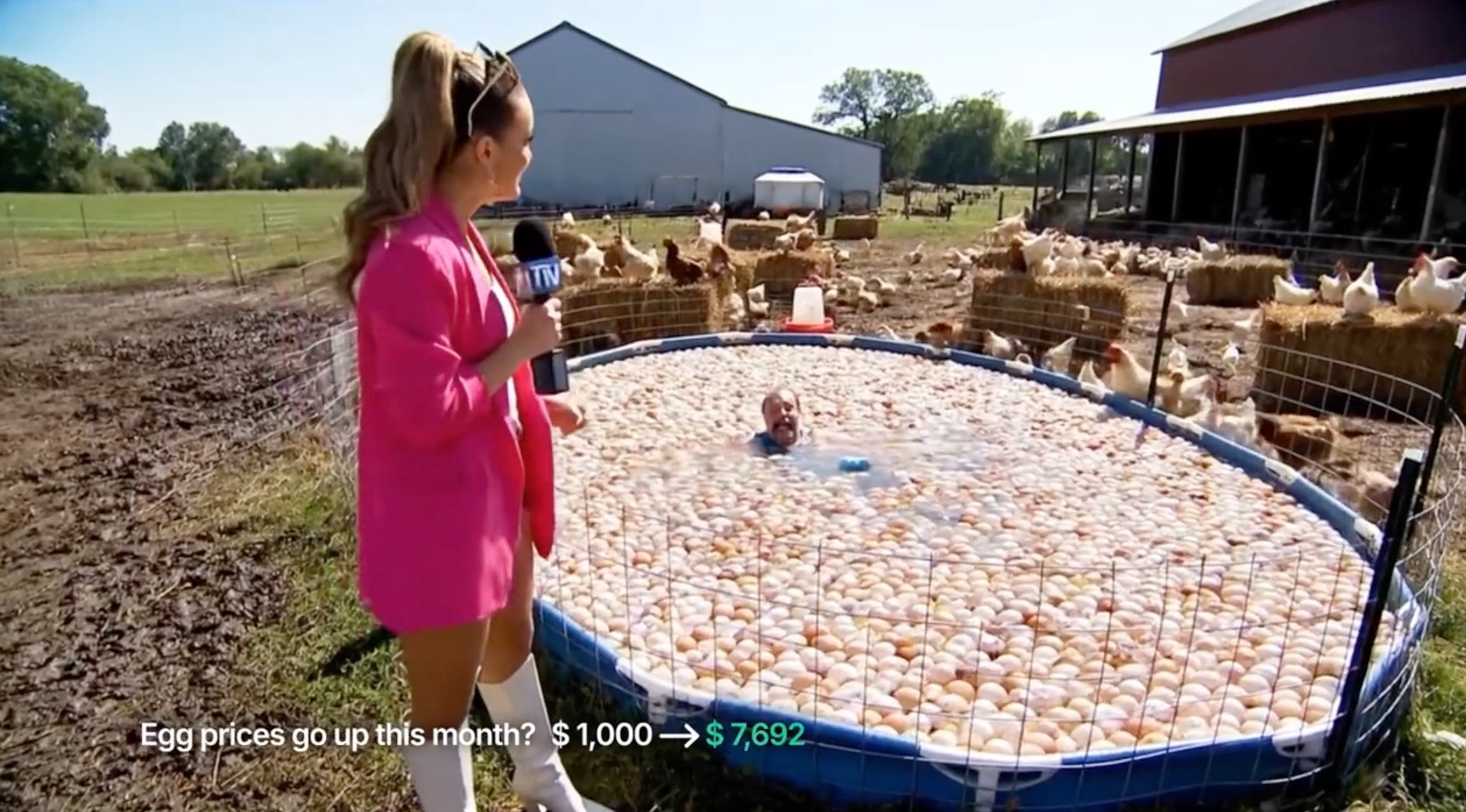
Click here to watch
What did we like about this campaign?
- Leaned into weirdness instead of hiding it: The surreal AI look became the joke rather than something to apologize for, which fits a brand built on chaotic real-world bets
- Tagline did real work: The world's gone mad, trade it ties the visual chaos directly to the product without a forced explainer
- Budget became the story: A $2,000 spot airing in an NBA Finals slot got Kalshi free press across The Verge, Ad Age, and Mashable
- Speed matched the moment: A 2-3 day turnaround meant the ad could reference the Indiana vs. OKC series specifically, something a traditional shoot could never have pulled off
- Right format for the medium: Short, punchy, meme-shaped cuts that work as well on TikTok and reel cuts as they did on broadcast
Breakout Clips
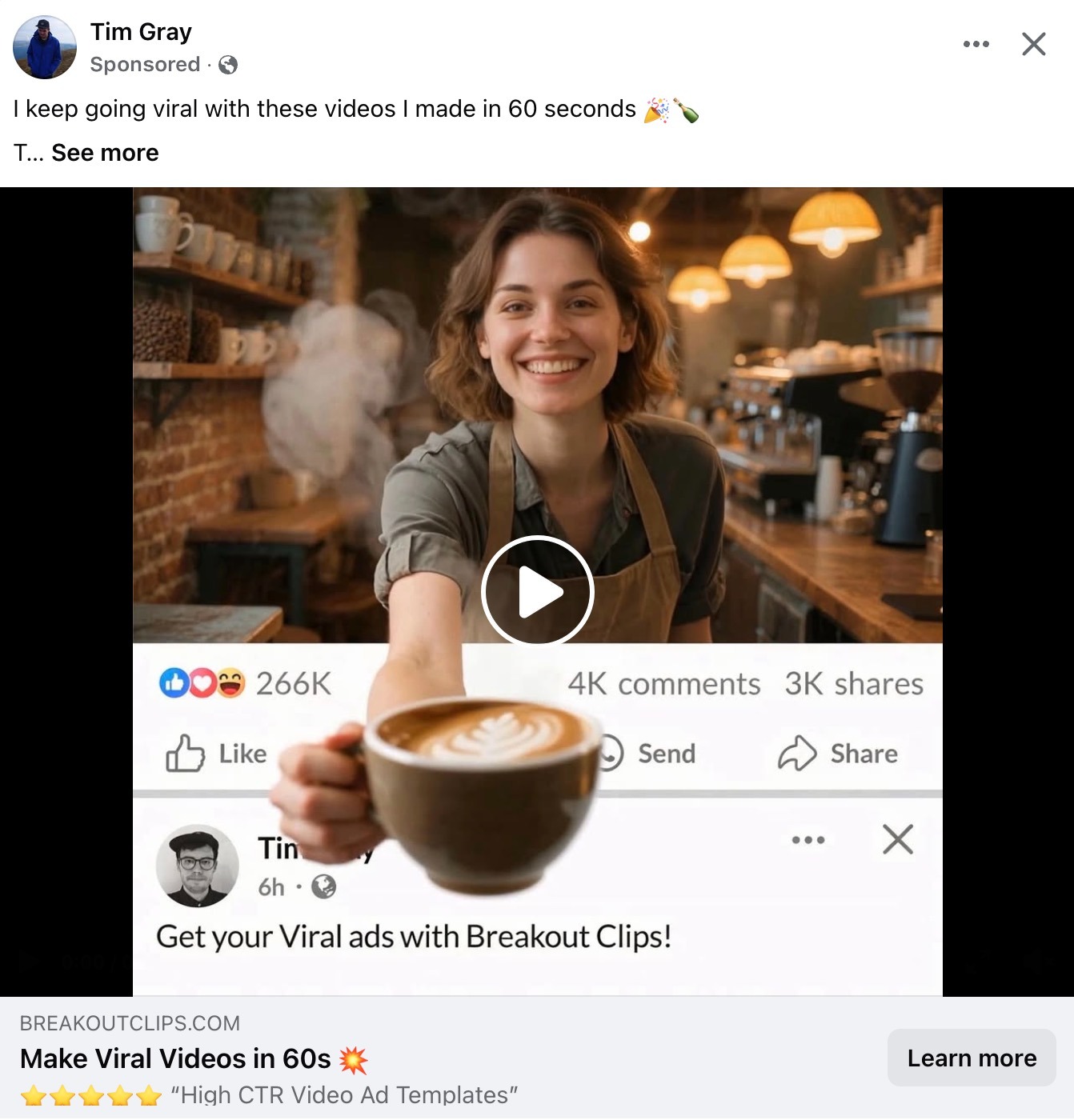
Breakout Clips is a tool that sells AI-generated video ad templates with the promise that you can spin up viral-style creative in about a minute. The ad itself is a meta example of the product in action: an AI-generated barista smiles into the camera and pushes a steaming cappuccino forward, with the cup breaking out of the post frame on top of a faked screenshot showing 266K reactions, 4K comments, and 3K shares. The whole spot is the pitch and the proof at once.
What did we like about this campaign?
- The breakout frame trick is the hook: the cup pushing past the post border instantly stops the scroll on a feed full of static thumbnails
- Product demoed itself: the ad is the template, so you immediately understand what you would get if you bought
- Social proof baked into the creative: faked reaction counts and comment numbers sit inside the visual instead of as separate copy
- Creator-style framing fits the platform: the sponsored post looks like a Tim Gray brag post, which reads more native than a polished brand ad
- Cheap to test at scale: a 60-second AI workflow lets them run dozens of hooks, products, and angles without a shoot
The Origin of Toys R Us
Toys R Us, the legacy toy retailer behind Geoffrey the Giraffe, used OpenAI Sora to produce what it called the first ever brand film made with the model. The piece tells the origin story of founder Charles Lazarus as a young boy, dreaming up a magical place that would change toy stores forever. The teaser shows a wide-eyed kid in suspenders staring up at swirling, dreamlike imagery, with a Toys R Us Studios sting in the corner. It was released in June 2024 as a teaser pointing viewers to the full film on Toysrus.com/studios.
What did we like about this campaign?
- Story choice fit the tool: A child imagining a fantastical world is exactly the kind of dreamlike, slightly unreal aesthetic Sora was good at producing in 2024
- Built a sub-brand around the experiment: Launching it under a new Toys R Us Studios banner gave them room to keep making AI-driven content without it feeling like a one-off stunt
- Reclaimed nostalgia without a reshoot: A brand that had largely disappeared from US storefronts got back into the cultural conversation using its own founder myth
- Teaser pulled traffic to owned channels: The YouTube cut is a hook, with the full film parked on Toysrus.com to drive site visits
- First-mover claim earned the press: Being the first brand film on Sora got coverage well beyond the toy category, which is the real point of the spend
Roast The Room
Hettich, a global furniture hardware brand best known for cabinet hinges, drawer systems, and pull-outs, ran a campaign called Roast The Room aimed at a younger audience that would never normally think about hardware. The team used AI to generate hyper-realistic visuals of disastrously messy, badly designed kitchens, wardrobes, and living spaces, then invited people on Instagram to roast each room in the comments. The follow-up content used AI again to redesign the same spaces, this time as clean, functional, beautifully styled rooms built around Hettich products.
What did we like about this campaign?
- Turned a boring category into a comment bait: Hardware brands rarely give people anything to react to, and a roastable messy kitchen is built for replies
- Two-part structure rewarded participation: The before and after format let users see their feedback paid off, which kept them coming back for the reveal
- AI fit the mess: Imperfect, slightly off AI visuals look genuinely lived-in and chaotic, which is exactly the vibe the campaign needed
- Tone did the heavy lifting: Humor and self-deprecation gave a hinge company permission to show up on a platform built for personality
- Showed the product without selling it: The redesigned rooms quietly featured Hettich hardware in context instead of running a spec sheet
Try Marpipe to bring AI creative to thousands of SKUs at once
The campaigns above all share something most marketing teams don't have: A six-figure budget, an agency partner, and a single hero ad to obsess over. If you're running catalog ads, the problem is the opposite. You have thousands of SKUs, one product image each, and a feed that was written for product pages instead of ads. Generative AI is the same unlock, but applied across the whole catalog instead of one spot.
That's what Marpipe's Generative Catalogs is built for. You connect your product feed, pick the AI models you want to run, and apply them across every SKU at once. A few of the things you can do:
- Generative text: Turn long product descriptions into punchy ad copy, and A/B test it against your default feed
- Generative image: Add lifestyle backgrounds, seasonal variations, and product-in-context shots without booking a photoshoot
- Generative video: Spin up motion, animated callouts, and Reels or TikTok native formats from your existing static images
- Localization: Generate translated, culturally adapted copy for every market you run in
- UGC at SKU level: Place brand-approved AI models with each product so the catalog looks shot, not stock
You control the prompt and the QA, so the output stays on-brand instead of looking like generic AI slop. If the Coca-Cola and Kalshi examples above made you wonder what AI could do for your own ad pipeline, book a demo with Marpipe here →