

Enterprise-level businesses need clean and scalable product data to manage listings across dozens of global markets. As AI shopping continues to grow, a brand’s data structure ultimately decides how well campaigns perform across Google Shopping, Meta, Amazon, and retail media networks. Productsup is one of the strongest tools for handling data governance and enterprise-level transformation, but the needs of global ecommerce continue to change. Marketing teams look for platforms that give them creative flexibility, better insights into catalog health, or a better connection between feed structure and real performance.
Productsup is able to process large and complex product catalogs at scale. Enterprise teams use it to create, validate, and transform data for different regions and channels. This helps ensure that their catalog stays up to date with compliance and changing marketplace rules. Productsup helps global brands manage everything from localization to data standardization, and advanced marketplace distribution. One of the main reasons why brands choose the platform is that it lets them control how data works throughout the company.
Teams, now, need more than just governance and rules. They need a way to understand how their feed affects their creative, how their creative impacts performance, and how all of these things work together as product catalogs change every day. Catalog ads, AI-powered placements, and automated creative workflows have made it necessary for teams to combine what used to be separate systems. That's why a lot of retailers are looking into other options that give them more information, faster time to market, or a more flexible way to work on catalog creative.

What are the best alternatives to Productsup?
Some of the best alternatives to Productsup include:
- Marpipe
- Feedonomics
- Channable
- DataFeedWatch
- ChannelEngine
- GoDataFeed
- Intelligent Reach
- Productspark
Marpipe
A lot of teams reach for Marpipe once they realize their product data and their catalog creative are influencing each other far more than they expected. It becomes clear pretty quickly that whatever is messy in the feed eventually shows up in the ads, especially on Meta, TikTok, and Google Shopping. When variants are missing or titles don’t line up, machine learning has a harder time placing products in the right spots. Marpipe steps in by helping teams clean their data and immediately put those improvements to work in their catalog templates and product level creative.
What teams like most is that it removes a lot of the guesswork that usually happens between merchandising, design, and performance. Instead of trying to trace where an odd title or wrong image came from, they can make a change in one place and instantly see how it affects the creative. That kind of clarity matters when you are running campaigns on fast moving channels like Meta Advantage+ Shopping or TikTok Shopping, where even a small inconsistency can lead to a noticeable drop in return on ad spend.
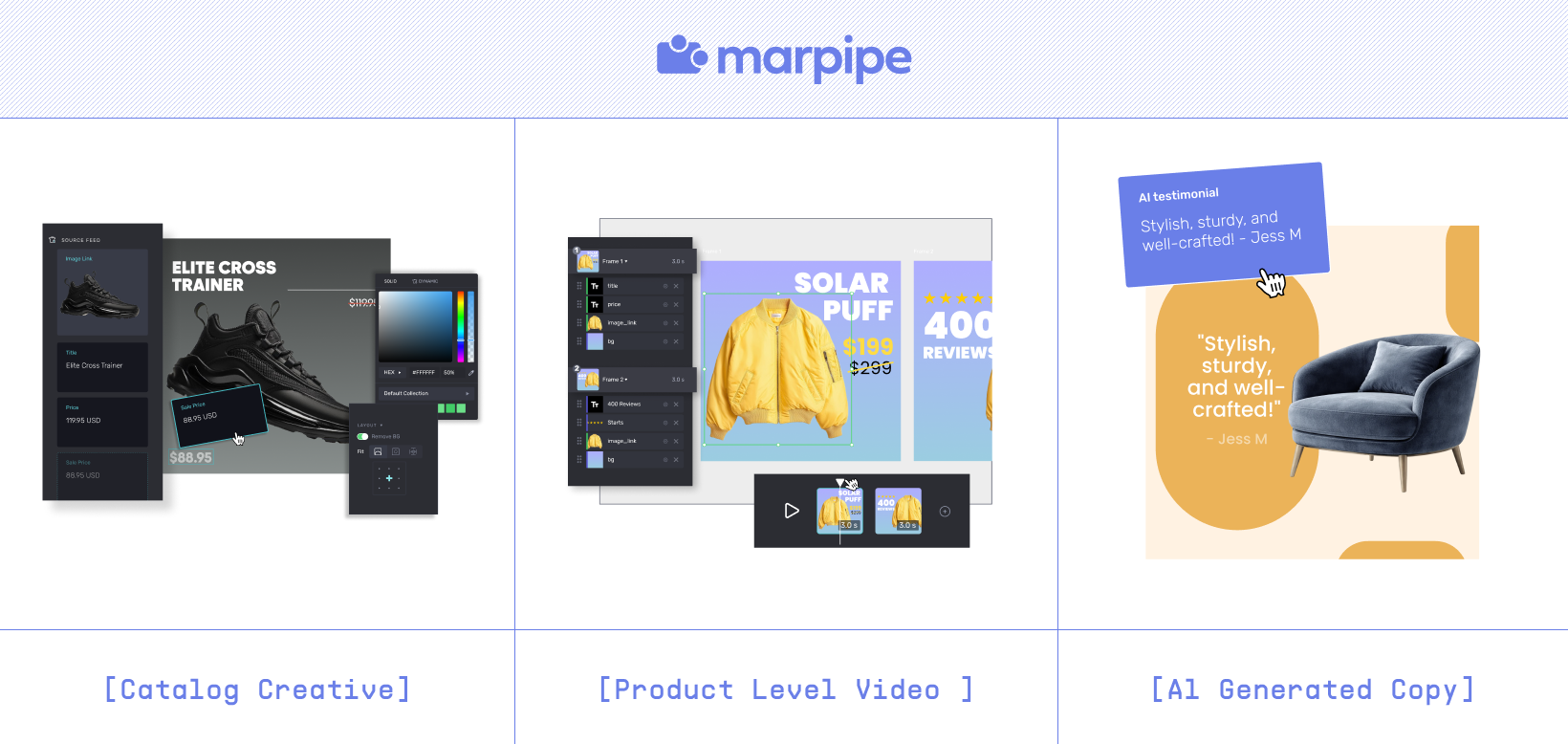
Marpipe is not meant to be a heavyweight governance tool. It is designed for the day to day work of performance marketers who need accurate data and flexible creative that keep up with a changing catalog. By tightening the connection between feed quality and creative output, it makes catalog automation more reliable and helps teams scale their templates, product level video, and generate better product copy for each SKU at scale. For brands that depend on catalog ads, that link between data and creative often becomes a key competitive advantage.
Feedonomics
When enterprise teams need a platform that can handle enormous catalogs, multiple regions, and the kind of governance that keeps things consistent while data changes every day, they often turn to Feedonomics. Because the infrastructure is engineered for scalability, retailers who work in more than one country or have thousands of SKUs commonly use it. It has transformation tools, custom logic, and formatting for each channel, which makes it a great choice for brands that have to make changes on Google Shopping, Meta, Amazon, and marketplace partners.
The managed service approach is a big reason why businesses select Feedonomics. They don't have to put all the strain on their own technical or merchandising teams because Feedonomics can handle a lot of the hard work for them. This is especially appealing to big stores who have a lot of different stores and complicated setups. BigCommerce often promotes it to global brands who require their data to be the same across all geographies and channels without having to create complicated operations in-house.
People often talk about Feedonomics and Productsup at the same time because they are both made for larger, enterprise-level businesses. Most of the time, the difference is how a team likes to work. Some companies want to be in charge of every change directly and hands-on. Some people like a managed team to take care of the day-to-day work. Feedonomics is always one of the best and most practical alternatives to Productsup for businesses who want a mix of automation, expert help, and global coverage.
Channable
Channable is a great choice for mid-sized retailers and agencies who need a clean, flexible workspace for managing feeds across multiple channels. It allows teams to set rules, test variations, and manage product visibility without struggling through complex logic or custom coding. This level of flexibility is useful for merchants who run frequent promotions or need to quickly update their catalogs across Europe’s growing marketplace ecosystem.
Channable is becoming more and more popular in Europe as marketplaces like Zalando, Bol, and Otto keep growing. The platform helps marketers keep everything in line by making sure that each of these platforms has its own rules, classifications, and formatting needs. By linking campaign data to the feed, teams can instantly see which SKUs need better titles, which versions aren't selling as well as they could, or which qualities are missing.
Channable is different from enterprise-level technologies that are built for stringent governance because it focuses on usability and daily work. It was made for groups who want to move rapidly and make smart changes without needing help from tech experts. Channable is typically the best choice for shops who seek a simple, easy-to-use alternative to more complicated platforms like Productsup.
DataFeedWatch
DataFeedWatch is a go-to choice for small and mid sized teams that want something simple, dependable, and easy to manage without the weight of an enterprise system. A lot of Shopify stores start here because the setup is quick, the rule builder feels intuitive, and it keeps Google Shopping, Meta, Amazon, and marketplace listings organized without slowing down day to day operations. For teams that don’t have a technical resource dedicated to feeds, that simplicity goes a long way.
Most brands pick DataFeedWatch when their main concern is staying ahead of Google Merchant Center errors or fixing the small inconsistencies that tend to spill into shopping or catalog ads. The platform makes it easy to spot issues, update templates on the fly, and keep product data aligned across channels so fewer surprises show up later in campaigns. In our breakdown of DataFeedWatch, we saw how helpful that ease of use is for Shopify and mid-market brands that just need a clean, predictable workflow.
Shopify’s annual Global Commerce Report consistently shows that SMB teams prioritize clarity, ease of use, and time savings when choosing ecommerce tools. DataFeedWatch fits that need well. It helps teams keep catalogs organized, listings accurate, and campaigns running smoothly without the complexity of an enterprise governance system. For retailers that find Productsup too heavy or structured for their current workflow, DataFeedWatch often becomes the more accessible and comfortable alternative.
ChannelEngine
ChannelEngine is a popular choice for brands that want to expand into selling their products in global marketplaces without switching to a comprehensive enterprise governance platform. It supports integrations across Europe, Asia, and North America and helps retailers manage listings, pricing, inventory syncing, and order flow. When teams wish to access more marketplaces than their existing technology can supply or need better synchronization between their storefront and external channels, they commonly add ChannelEngine to their process.
The platform is helpful for retailers with large volumes of marketplace orders or those entering new regions with different category structures and compliance rules. While it doesn’t have deep creative automation or advanced feed visualization, it excels at operational scale. It gives brands a way to centralize marketplace management without needing to build custom integrations for every single region.
ChannelEngine is a medium ground for businesses that have outgrown basic feed tools, but don't need the complete governance stack of Productsup. It focuses on global reach, order synchronizing, and operational efficiency.
GoDataFeed
When companies want structured feed management, clearer data, and formatting that works for each channel without having to buy an enterprise-level infrastructure, they generally look at GoDataFeed. It helps stores combine feeds, repair mistakes, and maintain listings up to date on Google Shopping, Meta, Amazon, Walmart, and other big channels. A lot of Shopify brands switch to it when their native Shopify feeds start to seem too constrained for making daily changes or fixing mistakes.
We recently reviewed GoDataFeed in Top Shopify Product-Feed Apps for 2025, and concluded that the platform finds a good mix between power and ease of use. The UI is easy for in-house teams to use, yet it still lets you do comprehensive attribute mapping, rule-based optimization, and tailor feeds for dozens of various channels. Shopify businesses who want more control without having to hire a developer or agency to handle every update will find that balance highly enticing. The diagnostic tools are also very useful since they help teams see faults, mismatched variations, or missing properties that commonly cause disapprovals or poor performance.
GoDataFeed gives brands structure without the cost of an enterprise system. This is great for firms who only need to manage a few major sales channels and want to focus on speed and accuracy. It wasn't made for sophisticated global governance or creative automation, but it's still a good choice for Shopify and mid-market teams that want a workflow that stays easy to manage as their catalog increases.
Intelligent Reach
Brands that require greater product visibility analytics and feed management often use Intelligent Reach. It shows teams how well each SKU, marketplace, or channel is doing and points out which listings are missing out on sales. Retailers who want to know exactly how their feed quality influences sales will find this level of diagnostic detail useful.
The platform also has a wide range of marketplace coverage, automation capabilities, and seller analytics that help retailers improve their distribution. Intelligent Reach is quite useful for teams that feel stuck with Productsup's transformation-oriented process and want more performance-based aid on top of data structure control.
Productspark
Productspark is a newer company that helps multichannel merchants make it easier to share product data. It lets you create feeds in one place, connect to marketplaces, and make rule-based changes. A lot of smaller global retailers use Productspark to easily connect to new marketplaces without having to buy a full enterprise infrastructure.
Productspark doesn't have as many features as Productsup, but it does have a modern and simple interface that several mid-sized teams like. Its strength is that it helps companies swiftly reach more channels while keeping data structured across all platforms.
How to Choose the Right Productsup Alternative
The right alternative depends on where your team feels the most friction. Enterprise companies often need strict governance, consistency across regions, and the ability to track data lineage. Mid sized teams often prioritize speed, clarity, and a workflow that helps them make day to day changes without technical support. Creative heavy teams need a tool that brings feed accuracy and catalog creative closer together instead of forcing them into separate systems.
If your catalog changes frequently or you rely on machine learning driven placements, choose a platform that helps you update feeds quickly. Google and Meta emphasize structured, validated data in their documentation, which is why many marketers choose tools that make it easy to react to disapprovals or listing changes in real time. If you operate across multiple regions, look for tools with strong localization, marketplace coverage, and data governance.
The best fit is the one that reduces the number of handoffs between your feed, your creative, and your campaigns. When those pieces operate together, teams work faster and performance usually improves.
Make Your Feed and Your Creative Work as One System
Productsup has supported many global retailers as they scale their operations, but today’s catalog advertising and global selling require tools that offer more flexibility, more creative insight, or a closer connection between data and performance. The alternatives above cover a wide range of needs, including data cleanup, marketplace expansion, and advanced catalog creative.
Many teams run into the same challenge. The distance between their product data and the creative that customers see creates performance issues. When those systems are not aligned, small errors travel through the workflow and show up in ads, especially on platforms that rely on machine learning. Marpipe helps teams close that gap. It gives marketers a cleaner way to fix feed issues, understand how those fixes affect creative, and produce catalog ads that reflect what is actually in stock.
Teams can start with Marpipe’s free feed management platform or book a demo to understand how their catalog structure affects their creative output. It is a simple way to see how improving product data leads to better catalog performance across channels.

Frequently Asked Questions
1. How do I know if my team has outgrown Productsup?
Most teams realize they’ve outgrown Productsup when they need more flexibility in their day to day workflow or when updates require more steps than they want to manage. If your catalog changes frequently, if you’re relying heavily on catalog ads, or if your team struggles to connect feed changes to creative output, that is usually a sign you may benefit from a tool that is faster, more visual, or more directly tied to performance. Many brands also explore alternatives when they want global scale without the overhead of a strict governance system.
2. What should I consider while looking for an alternative to Productsup?
First, figure out where your present workflow is slow or hard. If catalog advertising makes up a big part of your paid performance, use a technology that connects feed accuracy directly to creative development. If you do business in more than one area, look for good localization and coverage in more than one marketplace. If the key problem is how easy it is to use every day, look for platforms that make it easier to add rules, fix mistakes, and update catalogs. The greatest option is the one that cuts down on handoffs and lets your team work faster with fewer back and forth.
3. Can a mid-market feed platform replace Productsup?
Yes, for a lot of brands. If your organization doesn't have to cope with the difficulties of operating in many areas, rigorous internal rules, or complicated merchandising workflows, a mid-market solution might have everything you need with less work. Channable, DataFeedWatch, and GoDataFeed are some examples of platforms that cover the basics and are easier to use internally. Enterprise shops with complicated structures may still choose Productsup or Feedonomics, but products made for speed and ease of use are frequently better for mid-sized teams.
4. Does Marpipe work with Productsup, or can it take its place?
Marpipe was made to help with a distinct element of the workflow, but it may help teams in both areas if they need it. Productsup is made for deep governance, structured data transformation, and distributing catalogs all across the world. Marpipe's main goal is to help teams clean up their product data and implement those changes right away in their catalog creative. This is especially important on channels like Meta and TikTok, where feed accuracy has a direct impact on performance.
Many stores integrate Marpipe with an enterprise feed platform because it lets them manage how products show up in ads without having to wait for protracted technical upgrade cycles. But for mid-market Shopify teams with smaller catalogs or fewer geographies, Marpipe's feed tools can take care of the daily cleaning, fixing mistakes, and creative alignment on their own. The choice usually depends on how complicated the catalog is and how much control the organization needs.
5. When should I rethink my company’s whole feed setup instead of just changing tools?
If you keep getting Merchant Center issues, variants that don't match, catalog updates that take a long time to show up, or advertising that show old information, it might be time to reassess not only the platform but also the way you work. When the catalog changes, an effective feed system should make it easy to respond promptly. If your present structure slows down the merchandising, design, and performance teams, switching to a platform that brings all of those phases together or coupling your feed platform with a creative automation tool can make a big difference in how well things work.