


How you organize your Google Ads account decides how much control you keep and how much you hand to Google's automation. The same keywords and budget can perform very differently depending on whether they sit in tight, single-keyword ad groups or in broad, consolidated campaigns built to feed Smart Bidding.
There is no single structure that wins every time. The right one depends on your traffic volume, your budget, how much time you have to manage the account, and how much you trust automation. Below are 8 of the most common Google Ads campaign structures, with the pros, and cons of each one.
Single Keyword Ad Groups (SKAGs) with Alpha/Beta Structure
A SKAG puts one keyword in its own ad group so the ad copy and landing page can match that exact search. The Alpha/Beta version runs two campaigns on the same keywords. The Beta campaign uses broad or phrase match to discover new search terms, and the winning terms get promoted into the Alpha campaign as exact-match SKAGs. The Alpha campaign holds your proven performers and gets the bigger budget.
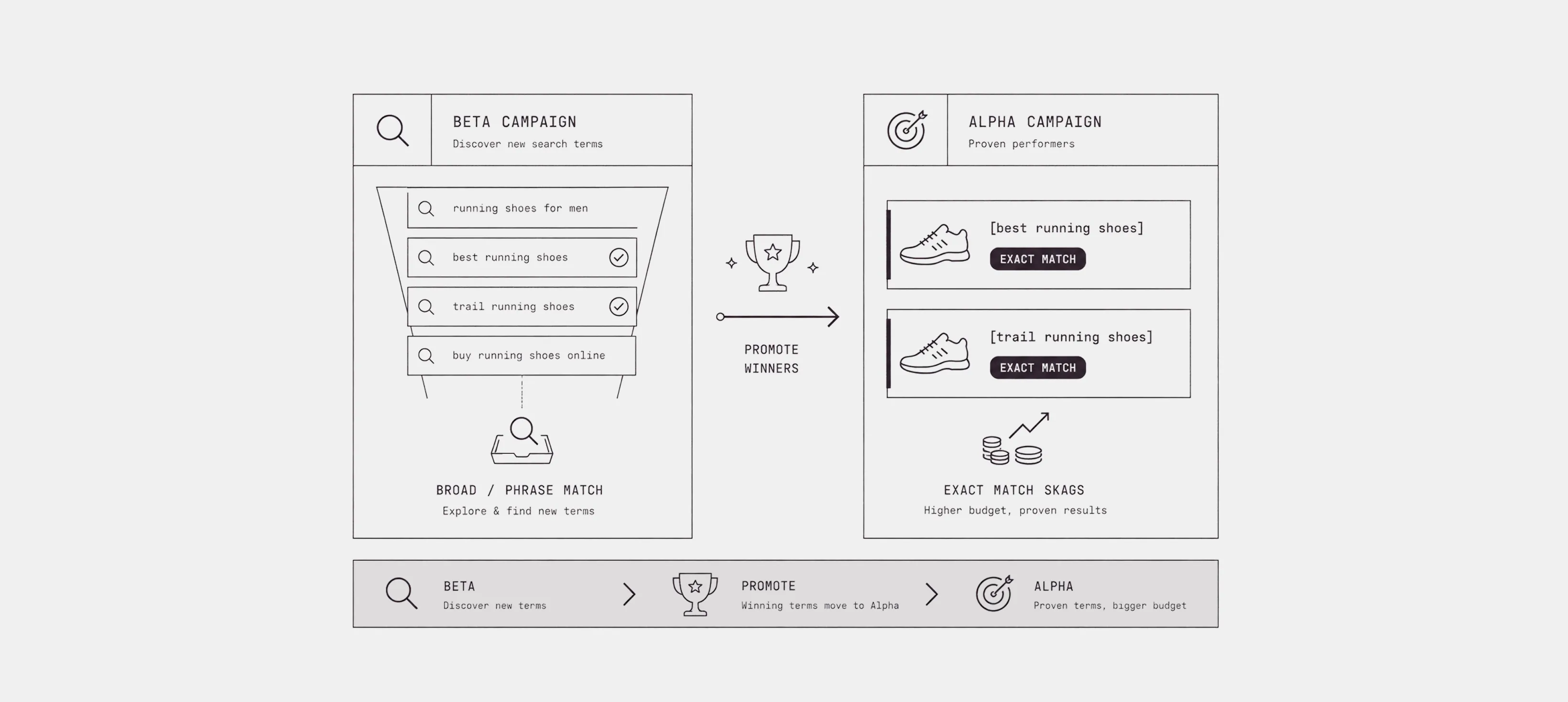
Brands use it when there's high-value keywords, they need tight control over messaging and spend matters more than scale.
Pros:
- Ad copy and landing pages match the keyword closely, which can lift relevance and Quality Score.
- You get clear control over which search terms you pay for.
- The Beta campaign gives you a steady pipeline of new terms to test.
Cons:
- Close-variant matching means even exact match now triggers on similar terms, so the tight control SKAGs promised has weakened.
- Splitting traffic into hundreds of tiny ad groups starves Smart Bidding of data.
- It is time-consuming to maintain and easy to overbuild.
Single Keyword Multi-Match-Type Ad Groups
This structure also builds around one keyword per ad group, but instead of running separate Alpha and Beta campaigns, you put two or three match types of the same keyword inside a single ad group. A common setup is exact match plus phrase match, or exact plus broad. Exact catches the precise query, while the looser match types capture related searches you did not think to add.
Use it when you want some of the control of SKAGs but a leaner account that is easier to manage and gives Smart Bidding more data to work with.
Pros:
- Fewer campaigns and ad groups to maintain than the Alpha/Beta setup.
- More data collects at the ad group level, which helps Smart Bidding learn.
- You still keep the keyword-level focus that makes ad copy relevant.
Cons:
- The different match types can compete against each other in the auction.
- With Smart Bidding on, you lose true keyword-level bid control.
- You still need cross-ad-group negative keywords to steer traffic to the right match type.
Theme-Based Ad Groups (STAGs)
Theme-based ad groups, sometimes called Single Theme Ad Groups, group a small set of closely related keywords around one topic instead of isolating each keyword. Since Google expanded close-variant matching, exact-match keywords often trigger on similar searches anyway, which made SKAGs harder to control. Grouping by theme accepts that reality and concentrates more traffic and conversions into each ad group, which suits Smart Bidding and Responsive Search Ads.
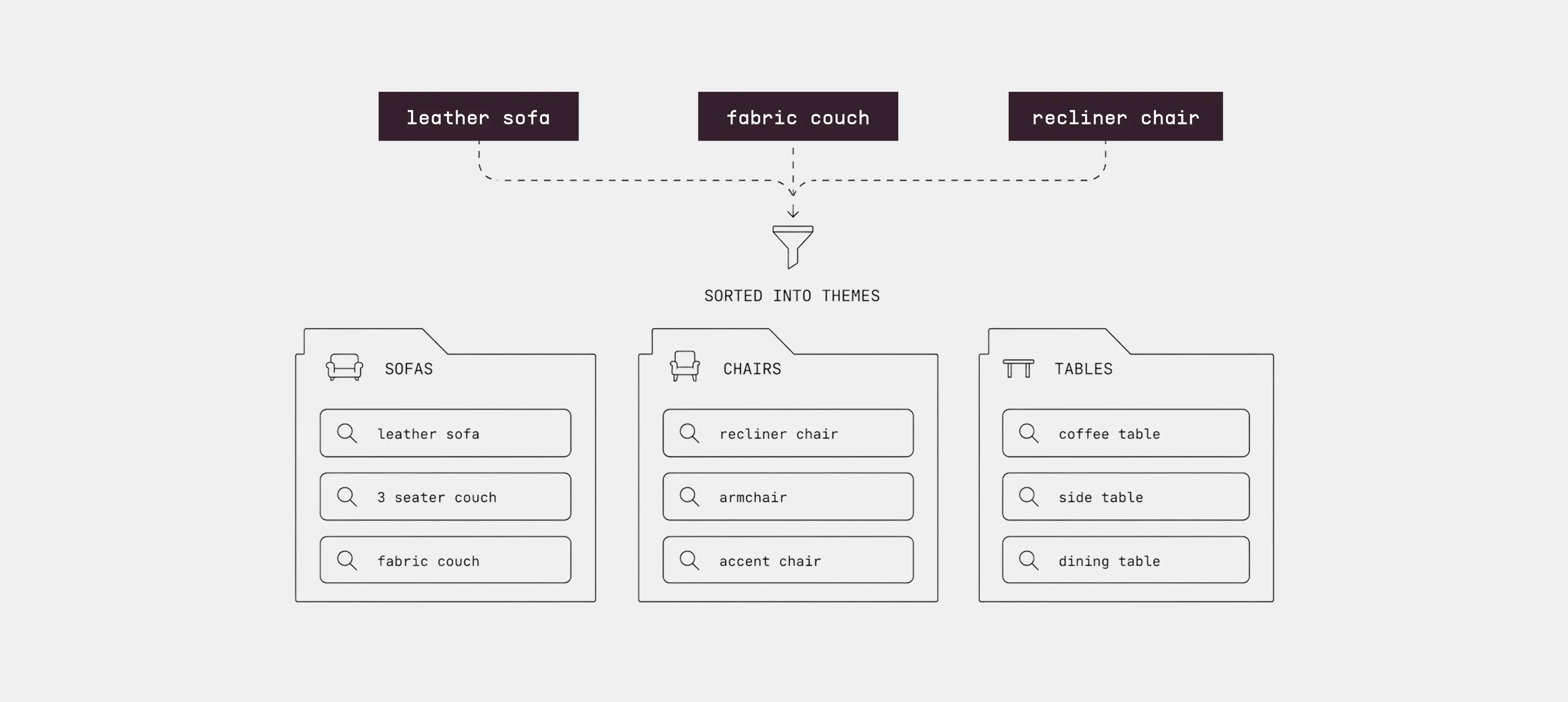
For example, a furniture retailer builds a "leather sofas" ad group holding "leather couch," "leather sofa," and "genuine leather sofa," then writes ads that speak to that whole theme rather than a single phrase. The retailer keeps a separate "fabric sofas" theme so the messaging and landing page stay distinct, and lets Smart Bidding optimize across the pooled traffic in each group.
Most brand ad accounts use it today, especially where they want a balance between relevance and giving the algorithm enough data to learn.
Pros:
- A leaner account with fewer ad groups to manage.
- More conversion data per ad group, which helps Smart Bidding perform.
- Responsive Search Ads have enough traffic to test ad variations properly.
Cons:
- Ad copy is slightly less tailored than a one-keyword-per-group setup.
- Defining clean themes takes upfront planning.
- Search term review and negative keyword work still need regular attention.
Campaigns Split by Keyword Performance
In this structure you group keywords by how they perform rather than by topic. You pick a metric first, such as CPA, ROAS, or conversion rate, then separate strong performers from weaker ones into different campaigns. The reasoning is that when high-performing and low-performing keywords share one campaign under Smart Bidding, the strong keywords end up subsidizing the weak ones, and a single bid target cannot serve both well.
Use it when you have large, mature accounts with plenty of data, where you want to protect efficient keywords from being dragged down by poor ones. This is one of the less common approaches.
Pros:
- Strong keywords are not forced to compensate for weak ones under a shared target.
- You can set realistic, separate bid targets for each performance tier.
Cons:
- Data gets scattered across many campaigns, which can hurt learning.
- Keyword performance shifts over time, so groupings need constant rebalancing.
- Search term and negative keyword management gets messy fast.
Broad Match with Smart Bidding
This structure leans into Google's automation. You use broad match keywords and pair them with a Smart Bidding strategy such as Target CPA or Target ROAS. Broad match shows your ads on a wide range of related searches, and Smart Bidding uses live auction signals, like device, location, and intent, to set a bid for each query. Google has pushed this combination heavily, arguing that broad plus Smart Bidding reaches buyers that tighter match types miss.
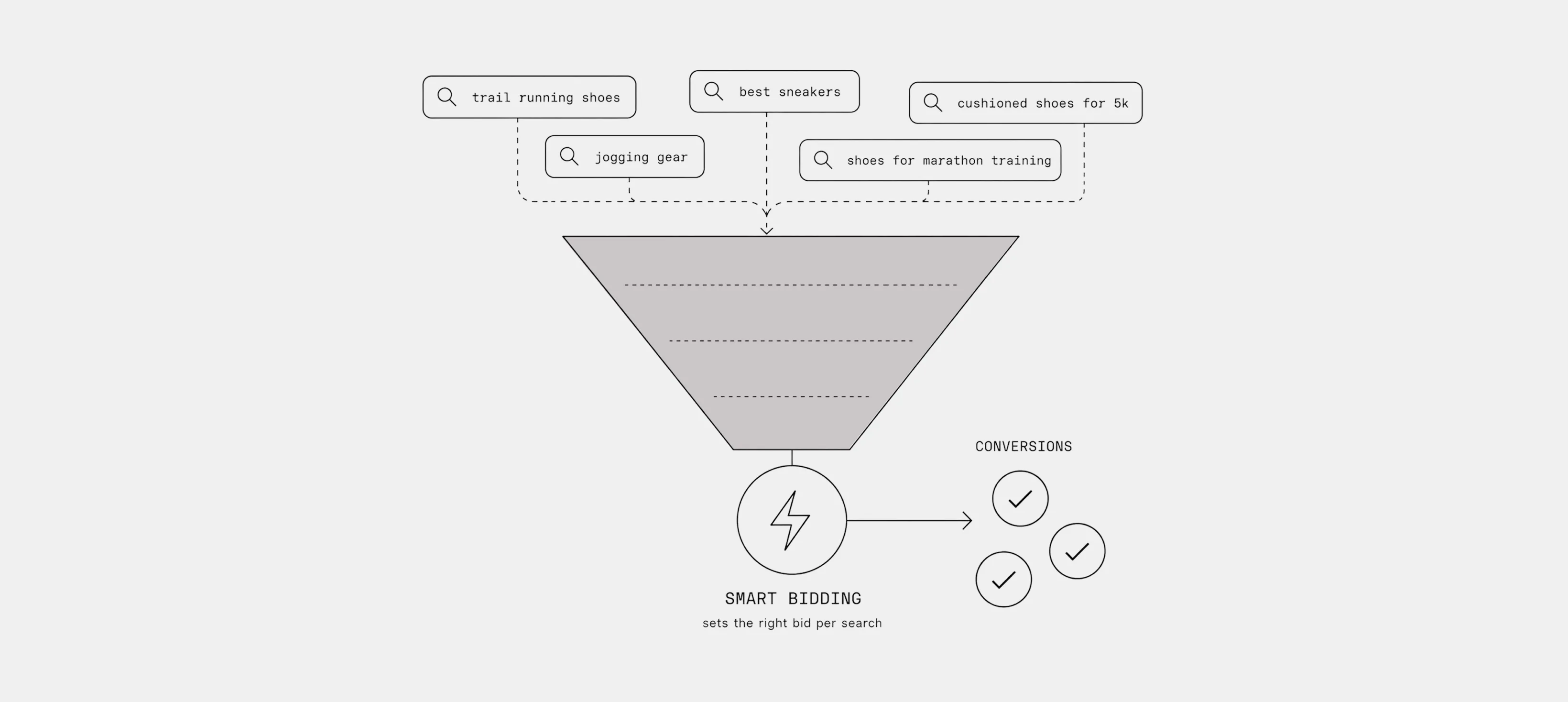
It is best for accounts with steady conversion volume and clean conversion tracking, often layered on top of an existing exact or phrase setup rather than as a starting point.
Pros:
- Captures extra qualified traffic you would never add as keywords manually.
- Smart Bidding adjusts the bid for each search in real time.
- Works with Google's recommended approach instead of against it.
Cons:
- You give up most of your control over which searches you pay for.
- It needs heavy and ongoing negative keyword work to stay efficient.
- Google hides a share of search terms, so visibility into spend is limited.
Campaigns Split by Audience or Age with Smart Bidding
Here you split campaigns by an audience trait, most often age group, so you can steer budget toward the segments that are worth more to you. This matters because Smart Bidding does not allow manual bid adjustments the way manual bidding does. If 25-34 year olds have a higher lifetime value than 18-24 year olds, separating them into different campaigns lets you set different targets and budgets for each.
Let's say a meal-kit subscription brand finds that older customers stay subscribed longer, so it runs separate campaigns by age band and sets a more aggressive Target CPA on the higher-retention groups. It feeds purchase value back to Google for each segment, which lets the bidding lean into the audiences with the strongest long-term return.
It is best for accounts with enough volume per segment, and businesses where lifetime value or churn varies clearly by audience, such as subscriptions.
Pros:
- You can budget around the real value of each audience segment.
- It restores some control that Smart Bidding otherwise removes.
- Reporting by segment becomes much clearer.
Cons:
- Splitting campaigns scatters data and can slow down Smart Bidding learning.
- The account gets heavier and more complex to maintain.
- Adding new keywords means repeating the work across every split.
Dynamic Search Ads (DSA) Campaigns
Dynamic Search Ads work without keywords. Instead of matching to terms you choose, Google crawls your website, builds an index of your pages, and matches user searches to the most relevant page. It then generates the ad headline from that page and the matching query, and you only write the description lines. Marketers usually run DSAs in their own campaign and organize ad groups by page or category for easier control.
Use it if you have a site with a large or frequently changing inventory, and as a way to capture searches your keyword campaigns miss. Note that Google is upgrading DSA campaigns to its AI Max format starting in February 2027.
Pros:
- Reaches very specific or rare searches you would never add as keywords.
- Quick to set up since you only write descriptions.
- Adapts automatically as you add or remove pages and products.
Cons:
- You do not control the auto-generated headlines or which queries you match.
- It needs steady negative keyword work to stay on target.
- Frequent page or URL changes can break targeting or cause errors.
The Hagakure Method
The Hagakure method is the most consolidated structure on this list. The goal is the simplest possible account, with traffic concentrated into as few ad groups as possible so Smart Bidding has dense data to learn from. Google has suggested aiming for around 3,000 weekly impressions per ad group, which usually means using broader match types, DSAs, or building the structure around landing-page URLs instead of long keyword lists. The trade-off is that you give Google most of the control.
It is for higher-spend accounts with strong conversion volume and clean tracking, where you are ready to step back from micromanaging and let automation run.
Pros:
- A simple structure that is fast to set up and easy to maintain.
- Dense data per ad group helps Smart Bidding work at its best.
- Far less day-to-day account upkeep.
Cons:
- You hand over almost all control to Google.
- Excluding irrelevant searches still takes ongoing effort.
- It needs real volume to work, so it is a poor fit for small or new accounts.
Which Google Ads structure should you use?
The choice comes down to how much control you want versus how much you hand to Google's automation.
Tighter structures like SKAGs give you control over messaging and spend but split your data into small pieces, which slows down Smart Bidding. Looser structures like broad match or Hagakure feed the algorithm dense data and cut your workload, but you give up visibility into what you are paying for.
Three things decide which side of that trade-off fits you.
- Conversion volume. Smart Bidding needs a steady flow of conversions to learn, so low-volume accounts often do better with more manual control, while high-volume accounts can let automation run.
- Time. Granular structures like SKAGs or campaigns split by performance need ongoing maintenance, whereas consolidated ones mostly run themselves.
- How much you trust automation with your budget.
Use the table below to match your situation to a starting point. You do not have to pick only one. Many accounts run a consolidated structure for scale and add a tighter campaign for their highest-value keywords.
If you are starting out or working with limited volume, theme-based ad groups are the safest default. If you have strong volume and want efficiency, broad match with Smart Bidding or the Hagakure method will usually serve you better. Whichever you pick, test it against the same goal you are running now before you commit the whole account to it.
Choose Marpipe when your Search is dialed in but Shopping isn't
Everything above is about Search, where structure is your main lever. But most accounts running Search are running Shopping too, and Shopping plays by different rules. There are no keywords to group and no ad groups to structure. Google decides which products show for which searches based almost entirely on your product feed. That changes the job.
On Shopping, the levers you actually control are the feed and the creative. The same tension this whole guide is about, how much you keep versus how much you hand to Google's automation, shows up here as well. The difference is that the inputs you give Google's algorithm are your product data and your ad creative, and those are the parts you can still own.
That is the job Marpipe is built for. Instead of stitching together a feed tool, a creative tool, and a testing setup, you run all three in one place:
- Clean up and optimize product titles and attributes so the right products surface for the right searches, the Shopping equivalent of getting your relevance right.
- Group products into the segments that match how you actually want to bid and budget, without paying the per-SKU costs that feed tools like Feedonomics or DataFeedWatch charge as your catalog grows.
- Generate branded ad creative straight from your feed instead of shipping bare product images, and test variations to find what performs.
- Surface your top-performing products so budget follows what is already working, including video.
The result is less tool sprawl, lower cost as your catalog scales, and a Shopping setup where the inputs feeding Google's automation are working as hard as your Search structure is.
If your Search account is dialed in but Shopping is still running on a raw feed and default creative, that is the next place to find efficiency. Book a demo with Marpipe to see how it optimizes Google Shopping.
Frequently Asked Questions
What is the best campaign structure for Google Ads?
There is no single best structure for every account. The right choice depends on your traffic volume, budget, time to manage, and how much you trust automation. Low volume accounts that want control often suit theme based or multi match type ad groups, while high volume accounts lean toward broad match or the Hagakure method.
Are SKAGs still worth it?
SKAGs have lost some of their edge because close variant matching means exact match keywords now trigger on similar searches, which weakens the tight control they once promised. They also split traffic into tiny ad groups that starve Smart Bidding of data. They can still help on a few high value keywords where messaging control matters most.
What is the Hagakure method in Google Ads?
The Hagakure method is a consolidated account structure that concentrates traffic into as few ad groups as possible, so Smart Bidding has dense data to learn from. Google suggests aiming for around 3,000 weekly impressions per ad group. It suits higher spend accounts with strong conversion volume that are ready to let automation run.
How many keywords should be in an ad group?
There is no fixed number, but most modern accounts group a small set of closely related keywords, often three to twenty, around one theme. This gives Responsive Search Ads enough traffic and feeds Smart Bidding more data than single keyword ad groups. The goal is tight relevance without splitting traffic into groups too small to learn from.
What is the difference between SKAG and STAG?
A SKAG, or single keyword ad group, isolates one keyword per ad group for maximum messaging control. A STAG, or single theme ad group, groups a few closely related keywords around one topic. STAGs pool more traffic and conversion data per group, which suits Smart Bidding and Responsive Search Ads, while accepting slightly less tailored ad copy.
Does campaign structure still matter with Smart Bidding?
Yes, structure still matters, but its job has changed. Instead of controlling bids keyword by keyword, structure now decides how much data each ad group feeds the algorithm and where you set separate targets. Splitting by audience or performance restores some control Smart Bidding removes, while consolidating helps the algorithm learn faster from denser data.
What are Dynamic Search Ads used for?
Dynamic Search Ads work without keywords. Google crawls your website, matches user searches to your most relevant page, and generates the headline automatically, so you only write the descriptions. They suit sites with large or frequently changing inventory and help capture rare searches your keyword campaigns miss. They do need steady negative keyword work to stay on target.