


If you run an ecommerce business long enough, you eventually hear the term “data feed,” usually when something breaks. A product gets disapproved. Prices don’t match. Ads stop serving. Someone says the feed needs fixing.
That’s often how feeds enter the conversation. As a problem.
In reality, an e-commerce data feed is doing quiet, constant work behind the scenes. It’s how product information leaves your store and shows up correctly on search engines, ad platforms, and marketplaces. Without it, modern ecommerce simply doesn’t function at scale.
This guide explains what an e-commerce data feed actually is, how it works in practice, why it matters more in 2026 than it used to, and how brands use feeds not just to distribute products, but to support advertising performance.
What an E-commerce Data Feed Actually Is
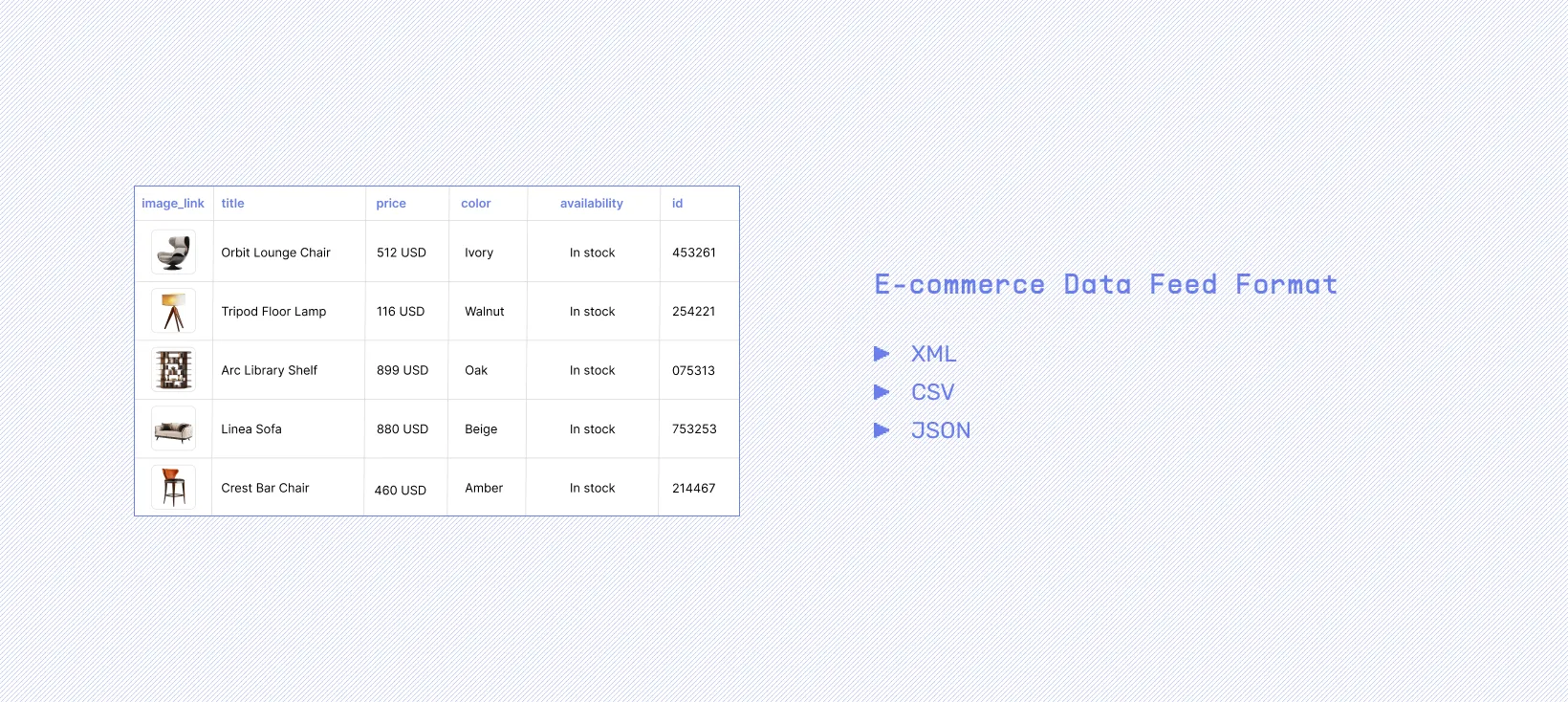
At its most basic level, an e-commerce data feed is a structured file that contains your product information. Each product is represented in a consistent way so external platforms know exactly what they’re looking at.
That file usually includes things like product names, prices, images, availability, and identifiers. It’s formatted so machines can read it easily and reliably. Most feeds are delivered as CSV, XML, or JSON files, depending on the platform receiving them.
What matters is not the format itself, but the structure. Platforms like Google Shopping or Meta catalogs are strict about what fields they expect and how those fields should be populated. If something is missing or mislabeled, products may not appear at all.
A helpful way to think about a feed is as a translation layer. Your ecommerce platform stores product data in one way. Advertising platforms and marketplaces need that same data, but in their own language. The feed makes that translation possible.
Why E-commerce Data Feeds Matter More Than They Used To
It’s tempting to think of data feeds as a technical requirement and nothing more. Something you set up once and move on from.
That view doesn’t really hold anymore.
In 2026, ecommerce is deeply multi-channel. Products show up in search results, shopping tabs, social feeds, dynamic ads, and marketplaces. All of those surfaces depend on structured product data.
A strong data feed helps in a few important ways:
- It keeps product information accurate across channels
- It reduces manual work when prices or inventory change
- It prevents disapprovals and silent failures
- It allows platforms to match products to the right queries and audiences
When feeds are weak, problems show up slowly. Visibility drops. Ads underperform. Teams spend time troubleshooting instead of optimizing. The feed becomes a bottleneck without anyone explicitly naming it as one.
How Data Feeds Work in Practice
Most data feeds start with the product catalog inside your ecommerce platform. That source data includes titles, descriptions, prices, images, inventory levels, and categories.
From there, the feed is shaped to meet the requirements of each destination. Google Shopping wants one structure. Meta catalogs want another. Marketplaces often have their own rules layered on top.
This shaping process can involve renaming fields, rewriting values, filling in missing attributes, or splitting one source field into several destination fields. Once formatted, the feed is connected to the platform, validated, and then used to generate listings or ads.
This is not a one-time process. Feeds refresh constantly. Inventory changes. Prices update. New products are added. Old ones are removed. A feed only works if it stays current.
This is also where complexity tends to creep in. One channel gets added. Then another. Rules stack up. Fixes get layered on top of fixes. Most teams don’t design feed systems from scratch. They grow into them. That’s normal.
Core Attributes You’ll See in Most Feeds
While requirements vary by channel, most e-commerce data feeds rely on a shared core of attributes:
- Product ID or SKU
- Title and description
- Price and availability
- Image URLs
- Brand and category
Additional attributes like color, size, material, or shipping details often become important later, especially for shopping ads and marketplaces.
How Data Feeds Support Advertising
Data feeds are not just for listings. They are critical for advertising, especially dynamic and catalog-based ads.
When a platform serves a product ad, it usually pulls information directly from the feed. Prices, images, product names, and availability are populated automatically. That allows advertisers to promote hundreds or thousands of products without building individual ads for each one.
When the feed is healthy, this works smoothly. Ads update automatically as products change. When the feed is unhealthy, problems can be subtle. Ads may show outdated prices. Images may fail to load. Products may quietly stop serving.
Advertising platforms depend on feeds because feeds enable automation. Without them, dynamic ads don’t exist.

Where Feeds Commonly Start to Break Down
For small catalogs, feed management can feel manageable. For larger catalogs, it rarely stays that way.
Common issues include missing attributes, inconsistent formatting between channels, delayed updates, and feeds that technically pass validation but are poorly optimized for performance.
There’s also a difference between a feed that is accepted and a feed that performs well. Platforms may allow a minimal set of data, but richer, more complete feeds tend to surface more often and perform better.
This is usually the point where manual workflows stop scaling.
What Feed Management Tools Actually Do
Feed management tools exist to handle this complexity. In practice, they help teams:
- Transform product data to meet channel-specific requirements
- Apply rules across large catalogs automatically
- Sync inventory and pricing reliably
- Detect and fix errors before platforms reject listings
Without automation, feed management becomes fragile and time-consuming.
Best Practices That Hold Up
Brands that manage feeds well over time tend to follow a few consistent practices:
- Keep source product data clean and up to date
- Add relevant attributes instead of relying on minimum requirements
- Customize feeds per channel rather than using one generic version
- Rely on automation instead of manual uploads
None of these is especially exciting. They’re just effective.
Where Marpipe Fits In
Once a feed is structured and flowing, another challenge becomes obvious. Even with clean data, ads can feel repetitive. Creative cycles slow down. Performance plateaus.
This is where Marpipe fits.
Marpipe uses your existing e-commerce data feed as the input for creative generation and testing. Instead of relying on a handful of static catalog layouts, teams can produce many variations automatically and test which ones perform best.
Feed tools make product data usable. Marpipe makes that data productive in ads.
When Feeds and Creative Work Together
When feed management and creative workflows are aligned, brands unlock:
- More ad variations without manual design work
- Faster learning across products and formats
- Better use of catalog data in dynamic ads
- More stable performance over time
This is often where meaningful gains appear.
Turning E-commerce Feed Data Into Performance With Marpipe
An ecommerce data feed is the backbone of product visibility. It connects your store to search engines, marketplaces, and ad platforms so products appear accurately and consistently wherever shoppers discover them. Getting that foundation right is essential.
In 2026, though, feed quality alone is not the finish line. Performance increasingly depends on how product data is activated in advertising, especially in dynamic formats where creative variation, testing, and iteration determine whether ads earn attention or get ignored.
This is where Marpipe fits naturally into the stack. It helps teams move from clean, structured feed data to scalable creative execution, turning catalogs into high-performing ads without relying on manual rebuilds or guesswork.

FAQs
What is an e-commerce data feed?
An e-commerce data feed is a structured file that contains product information so platforms like Google, Meta, and marketplaces can display products correctly.
Why are data feeds important for ecommerce?
They keep product details accurate across channels and allow ads and listings to update automatically as prices or inventory change.
What platforms use e-commerce data feeds?
Search engines, shopping ads, social ad platforms, and marketplaces all rely on data feeds to show products.
Do data feeds affect ad performance?
Yes. Clean, complete feeds help dynamic ads serve correctly and improve how platforms match products to shoppers.
How does Marpipe use e-commerce data feeds?
Marpipe uses feed data to generate and test catalog ad creatives at scale, helping brands learn what visuals and layouts perform best.