

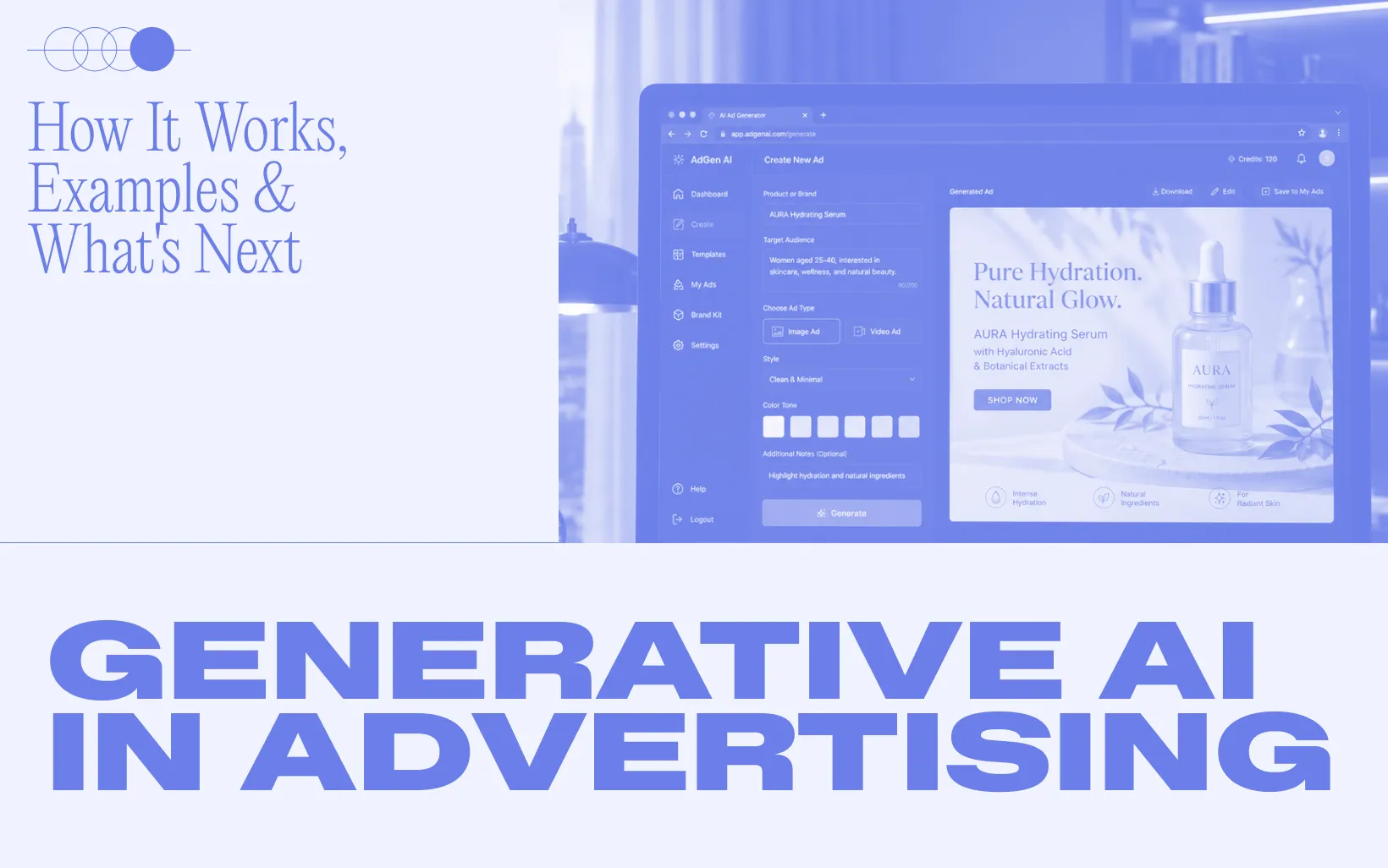
Most e-commerce teams already have the infrastructure to launch ads at scale. What they usually do not have is a reliable way to make those ads look better as volume grows. Product catalogs can push thousands of SKUs into Meta, TikTok, and Google in a few clicks, but the creative layer often stalls out long before distribution does. What gets published is usually the same familiar format: a product image, a title, and a price pulled straight from the feed. It is functional, but it rarely feels built for the placement.
That is where generative AI in advertising has started to become useful. Not because it replaces campaign management, and not because it writes ad copy faster, but because it gives ecommerce teams a more practical way to produce catalog creative at scale. This shift is already well underway, with 52% of marketers now using generative AI across multiple parts of their content production process to meet skyrocketing demand. At Marpipe, we see the strongest use cases from brands that use this technology to make catalog ads more adaptable and performant, turning raw product data into a scalable system of high-quality creative.
What Is Generative AI in Advertising?
Generative AI in advertising is the use of AI to create ad assets such as copy, layouts, images, and video variations automatically. In simple terms, it helps produce the creative parts of an ad instead of only helping distribute it. Traditional ad automation is built to improve delivery. It handles bidding, targeting, placements, and audience selection once a campaign is live. Generative AI does a different job. It improves what gets delivered by generating the assets that appear in the ad itself, including the message, the layout, the image treatment, and the creative variations used across placements.
This matters more in e-commerce because most brands do not struggle to launch product ads. Platforms already make distribution easy. The harder part is making those ads usable at scale when a catalog contains hundreds or thousands of products. That is where generative AI becomes more practical than traditional automation alone. In catalog-heavy environments, it helps solve the production problem behind the ad by turning product data into creative outputs that can be adapted, repeated, and refreshed across large product sets. Research from Gartner (2025) underscores this efficiency, noting that 77% of marketers now use generative AI for creative development, with some organizations reporting a 93% improvement in content production speed. Traditional automation decides who sees the ad. Generative AI helps determine what that ad actually looks like.
How Generative AI Actually Works for E-commerce Teams
Product Feeds Become the Creative Input
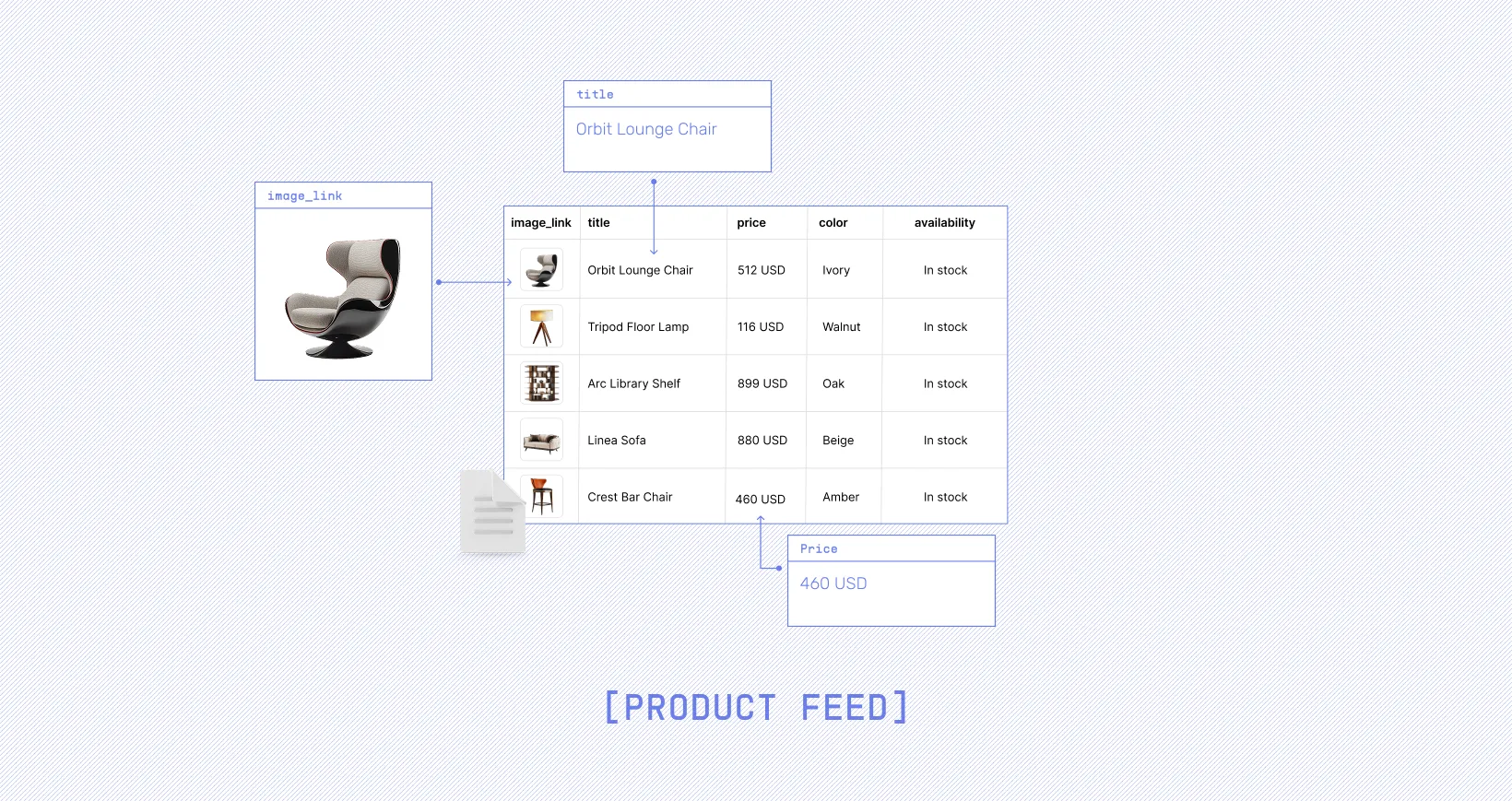
Every generative ad workflow starts with inputs. In e-commerce, the most useful input is the product feed. A product feed is the structured data behind your catalog. It includes product titles, descriptions, images, prices, variants, availability, and other attributes tied to each SKU. For generative AI, that feed is not just a source of inventory. It is the raw material used to generate creativity.
This matters because AI works best when the inputs are structured and repeatable. A clean product feed gives the system consistent information to work from, which makes it possible to generate creative across large product sets without rebuilding every asset manually. The stronger the feed, the more usable the output.
AI Applies Creative Rules Across the Catalog
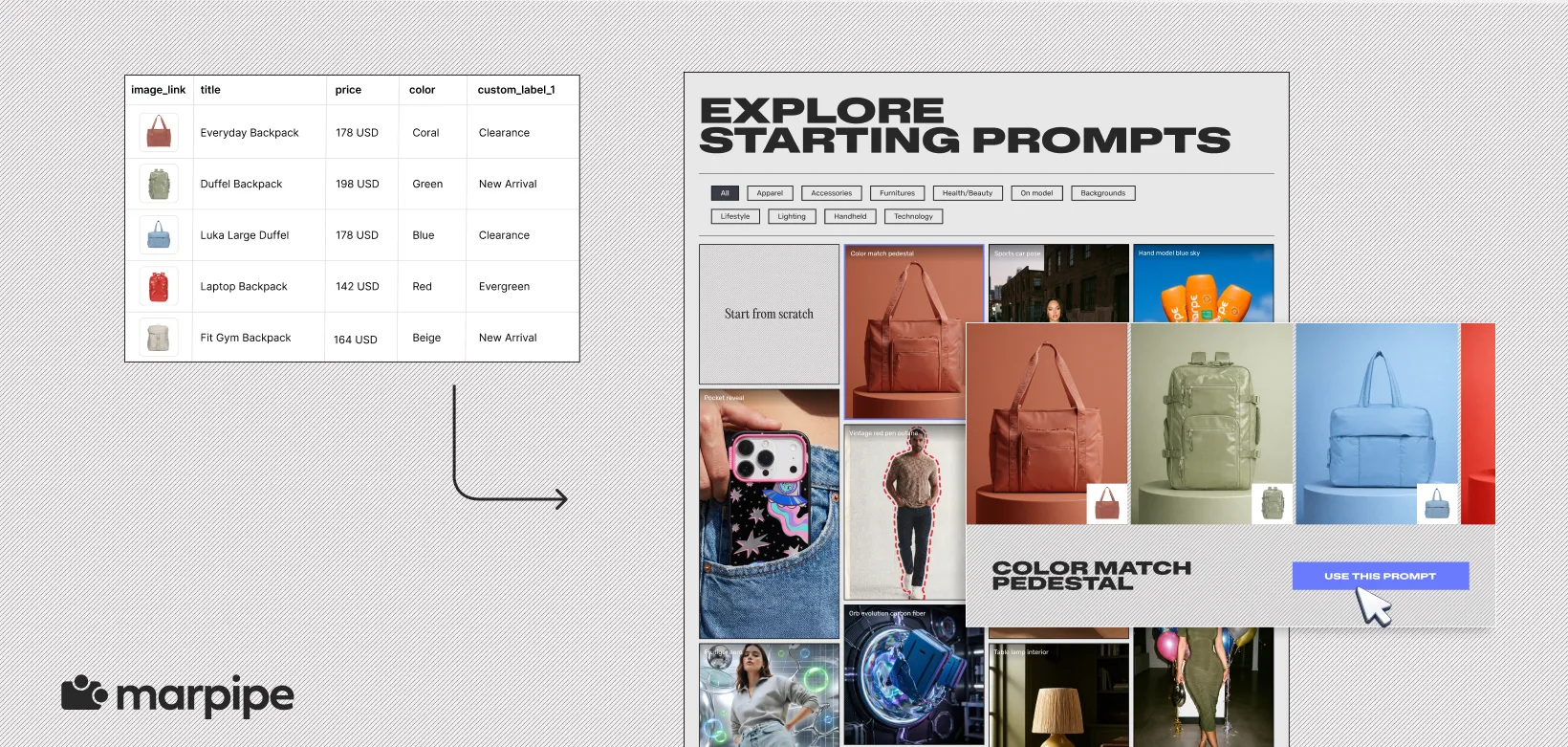
Once the feed is structured, AI can start applying creative rules across the catalog. This is where the workflow shifts from product data to creative production. Instead of designing ads one by one, teams apply repeatable logic across every eligible SKU. That can include branded backgrounds, promotional overlays, pricing treatments, ratings, badges, messaging, and layout decisions.
The practical value here is scale. AI is not helping teams make one ad faster. It is helping them apply the same creative logic across hundreds or thousands of products at once. That changes the workflow from asset production to system-based creative generation.
Creative Is Adapted for Every Channel
The same product does not perform the same way across every ad platform, and the creative should not stay static when the placement changes. A product image built for Meta may need different framing on TikTok. A Google Shopping placement may need a cleaner visual hierarchy than a paid social unit. Creative has to adapt to the format in which it appears.
Generative AI helps adjust those outputs automatically. It can reformat layouts, resize assets, shift text hierarchy, change pacing, and restructure visuals based on where the ad will run. That makes it easier to keep product creative usable across channels without rebuilding separate versions for every platform.
Performance Data Refines What Gets Produced Next
The most useful generative systems do not stop once the creative is published. They improve based on what happens after launch. Performance data helps determine what should be refreshed, what should be paused, and which products deserve more creative attention. That feedback loop is what makes the system useful over time.
This is where generative AI becomes operational. It is not just about producing more assets. It is helping teams make better decisions about what gets produced next. Instead of treating creative as a one-time output, ecommerce teams can treat it as a system that adjusts based on product performance, channel behavior, and what is actually converting.
Where Generative AI Is Actually Useful
Catalog Ads That Need More Than Default Templates
Most catalog ads are still built from the same basic template: product image, title, price, and little else. That is enough to populate inventory across paid channels, but not enough to make the creative competitive. The ad serves its function, but it rarely does much to stand out.
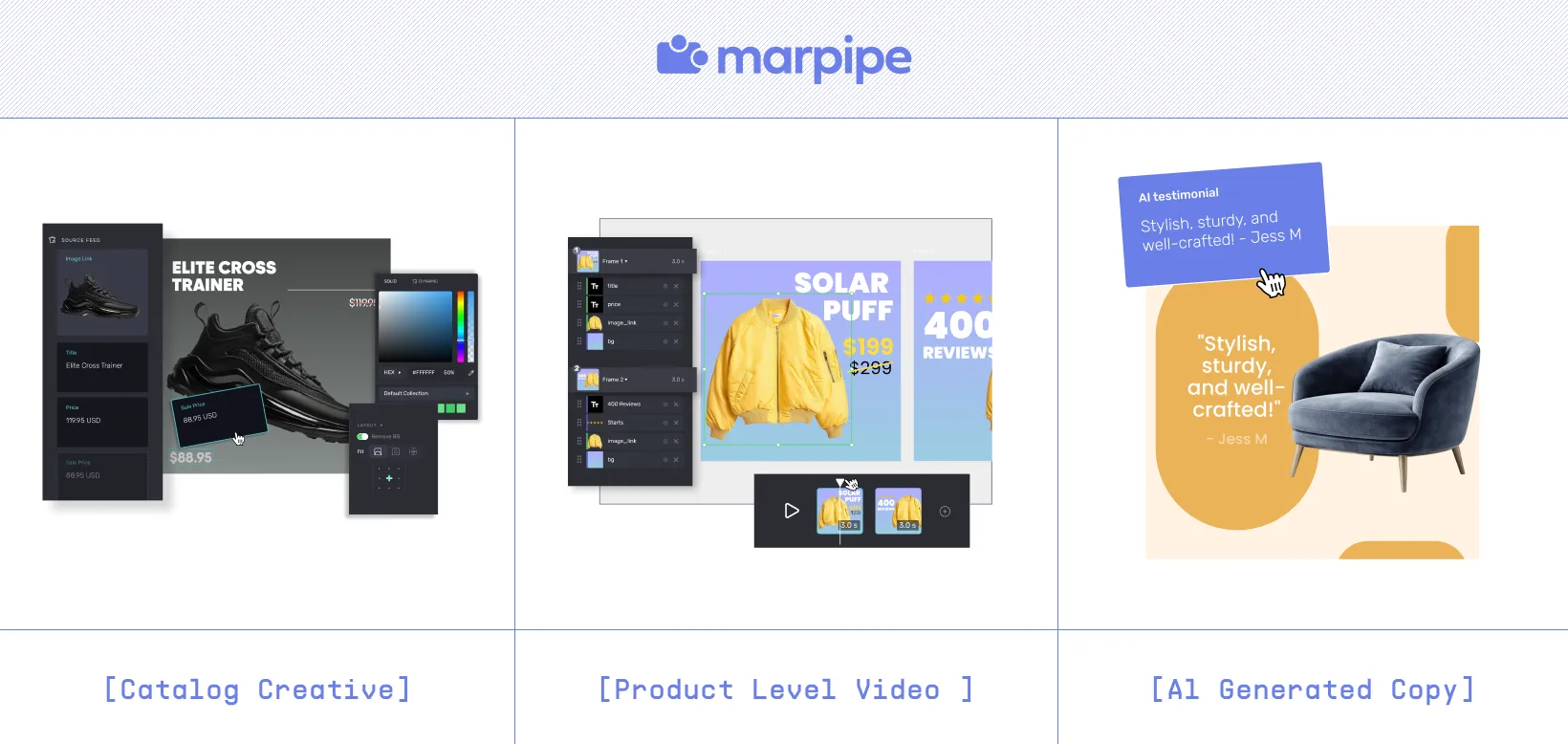
This is one of the clearest places where generative AI adds value. Instead of relying on the default format, teams can apply branded layouts, promotional overlays, stronger visual hierarchy, and better product framing across the catalog automatically. That shift toward structured catalog ad creative is what makes product ads feel less like listings and more like designed assets.
Product-Level Personalization Without More Production Work
Products should not all be presented the same way. A high-margin SKU, a discounted item, and a repeat-purchase product rarely need the same message or visual treatment. The challenge is not deciding what should change. It is applying those changes without creating more manual work.
Generative AI makes that easier to manage. Creative can shift by product, audience, or offer using different messaging, layouts, backgrounds, and promotional emphasis without requiring separate production for every variation. That makes personalization more practical in environments where scale usually forces everything into the same template.
Faster Refresh Cycles and More Usable Testing
Most teams do not run into creative problems because they lack ideas. They run into them. Most teams do not struggle to come up with new offers or test ideas. They struggle to get them live fast enough to matter. Production delays are what usually slow down testing, not a lack of ideas.
Generative AI helps remove that bottleneck. Updating offers, swapping messaging, refreshing layouts, and launching new variations takes less production time, which makes it easier to test more often and iterate faster. The gain is not just more output. It is a shorter time between idea, launch, and feedback.
Product-Level Video Without Manual Editing
Static product ads are harder to sustain in placements where motion is now the default. As more paid inventory shifts toward short-form video, static creative has less room to compete, especially in social feeds built around movement.
Generative AI helps extend product creative into those placements without requiring full video production for every SKU. Static images can be turned into lightweight motion assets with basic pacing, animation, and visual movement, which gives teams a more scalable way to produce video across the catalog.
Real Examples of Generative AI in Advertising
Coca-Cola used generative AI in its 2024 holiday campaign to speed up production on a global creative refresh. According to the company’s global head of generative AI, the campaign was produced about five times faster than a standard workflow. The value was speed and production efficiency. The tradeoff was creative quality. Public response was mixed, which made the limitation clear: generative AI can reduce production time, but it does not replace creative review.
A more useful example for e-commerce comes from performance media. StackAdapt reports that campaigns using AI-driven dynamic creative optimization saw 32% higher click-through rates and 56% lower cost per click. In one retail case study, Vallo Media used AI-based product ad personalization to re-engage cart abandoners and drove a 60% increase in click-through rate while generating 30% of ad-attributed revenue from 12% of campaign spend. This is where generative AI is most useful in advertising: improving creative output tied directly to performance.
What Generative AI Still Gets Wrong
Generative AI is effective at reducing production time, but it does not remove the operational constraints around creativity. Most of its failure points come from weak systems, not weak models. When output quality drops, the issue is usually not the AI itself. It is the workflow, inputs, and controls surrounding it.
- Generative AI increases output volume, but output volume is not the same as creative quality. Producing more assets does not improve performance unless the system generating them is grounded in clear positioning, strong creative rules, and a reason for each variation to exist.
- It does not correct weak inputs. Poor product data, incomplete attributes, inconsistent image quality, weak messaging, and unclear offers all carry through to the output. Generative systems do not solve input quality problems. They amplify them.
- Without clear constraints, it defaults to generic creative. Most models optimize for plausible output, not differentiated output. That usually leads to safe layouts, repetitive messaging, and creative that is technically usable but strategically interchangeable.
- Brand safety still requires human control. Generative systems can produce inaccurate claims, weak product framing, visual inconsistencies, and off-brand creative. Review, approvals, and compliance controls still need to sit outside the model.
- Most teams underestimate governance. Asset generation is the easy part. The harder part is controlling brand logic, approval systems, creative rules, legal constraints, and consistency across volume. This is where most AI workflows break down.
Generative AI works best inside a structured production system. When the inputs are clean, the rules are defined, and review is controlled, it improves efficiency. When those systems are weak, it scales inconsistency faster than most teams can catch it.
What’s Next for Generative AI in Advertising
The next phase of generative AI in advertising will be less about producing more assets and more about building better systems around them. The shift is already moving away from one-off creative production and toward modular, repeatable workflows where product data, creative rules, and performance signals work together. For ecommerce teams, that means fewer manual asset requests, faster iteration cycles, and more control over how creative gets produced across large catalogs.
That is where generative AI in advertising becomes more useful over time. Not as a replacement for creative teams, but as infrastructure for producing better catalog creative at scale. The teams that benefit most will not be the ones generating the most assets. They will be the ones with stronger inputs, tighter controls, and better systems for turning product data into usable creative. If that is the direction your team is moving, book a demo to see how Marpipe helps turn product catalogs into scalable creative systems.
Frequently Asked Questions
Can generative AI improve return on ad spend?
It can, but only indirectly. Generative AI improves the creative inputs that influence click-through rate, conversion rate, and product relevance. Better creative can improve efficiency, but generative AI does not improve return on ad spend on its own. The gain comes from faster testing, better product presentation, and more relevant creative across placements.
How much product data does generative AI need to work well?
It depends on the use case, but structured product data is the baseline. At minimum, generative systems need clean titles, pricing, product imagery, and consistent attributes. The more complete the feed is, the more usable the output becomes. Weak or inconsistent product data usually leads to weak creative.
Does generative AI replace creative teams?
No. It reduces manual production work, but it does not replace creative direction, strategy, or review. Creative teams still define positioning, set brand rules, control approvals, and decide what the output should accomplish. Generative AI changes the workflow. It does not replace the function.
Is generative AI useful for smaller product catalogs?
Yes, but the operational advantage is smaller. Brands with fewer SKUs can still use generative AI to speed up creative production, test more variations, and improve refresh cycles. The value becomes more obvious as catalog size, product turnover, and campaign complexity increase.
How do you measure whether generative AI is improving creative performance?
The same way you measure any creative system. Track click-through rate, conversion rate, cost per click, and return on ad spend against a control. The difference is that generative AI usually improves speed to launch, variation volume, and refresh cadence, so performance should be evaluated at both the asset level and the production level.