

Product data moves constantly in ecommerce. Prices change. Inventory shifts. Products go in and out of stock. New items are added, others are retired. All of that information needs to reach advertising platforms, shopping engines, and marketplaces accurately and on time.
For a long time, that movement relied mostly on static product feeds. Files are generated on a schedule, uploaded or fetched, then refreshed again later. That approach still works in many cases. But it also introduces a delay.
API data feed management exists to reduce that delay.
Instead of waiting for the next scheduled update, API-based feeds allow systems to exchange product data continuously. When something changes in your catalog, that change can be reflected almost immediately in the platforms that rely on it.
This guide explains what API data feed management is, how it works, when it makes sense to use it, and how it fits into modern ecommerce advertising workflows.
What an API Data Feed Is
An API data feed is a programmatic connection that allows product data to be sent directly from one system to another. Rather than exporting a file, your ecommerce platform communicates with external platforms through defined endpoints.
The term combines two ideas. An API, or Application Programming Interface, defines how systems talk to each other. A data feed is the structured product information that systems exchange. Together, they create a live connection for product data.
In practical terms, this means prices, availability, product attributes, and updates can be shared as they change instead of waiting for a scheduled refresh.
This does not eliminate structure. API feeds still rely on strict schemas, required fields, and validation rules. The difference is not what data is required, but how and when it moves.
Why API Data Feed Management Exists
Static feeds are snapshots. They work well when changes are infrequent or predictable. But many ecommerce businesses no longer operate in that kind of environment.
Inventory can change multiple times a day. Pricing may adjust based on promotions, demand, or availability. When product data lags behind reality, problems follow.
Outdated information can lead to ad disapprovals, wasted spend, and customer frustration. API data feed management helps reduce those gaps by keeping product data synchronized more closely across systems.
That said, APIs are not automatically better in every situation. They solve specific problems. They are not a universal replacement for every feed setup.
How API Data Feeds Actually Work
An API feed begins with authentication. Platforms provide credentials that allow secure access to their systems. Once connected, product data from your ecommerce platform is mapped to the structure expected by the destination.
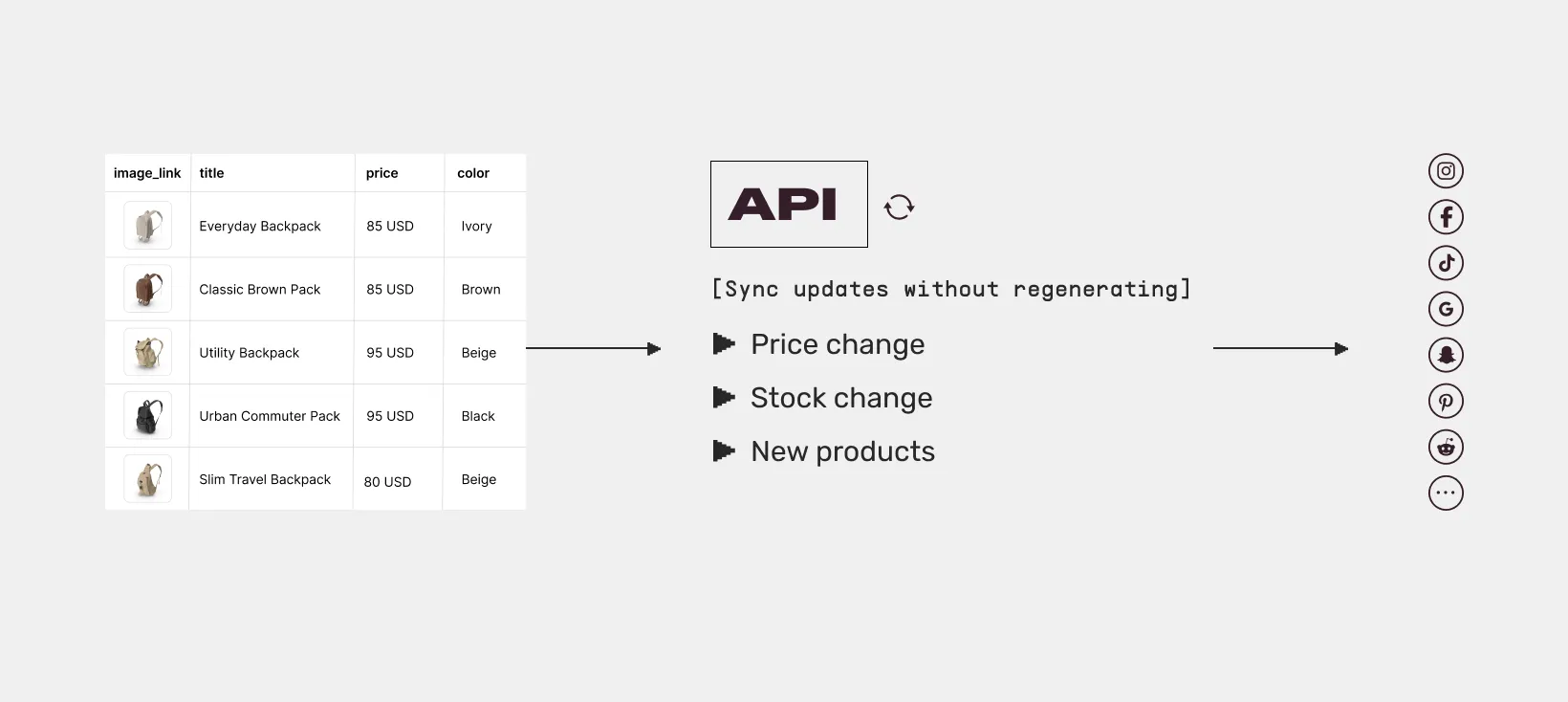
From there, updates are transmitted programmatically. A price change, a stock update, or a new product can be pushed without regenerating an entire feed file.
The receiving platform validates that data just as it would a static feed. If something is missing or incorrectly formatted, the update can fail. Monitoring and error handling still matter.
Because updates happen continuously, API feeds tend to surface issues faster. Problems are not hidden until the next scheduled upload.
API Data Feeds vs Static Product Feeds
The difference between API feeds and static feeds is not about capability alone. It comes down to timing and control.
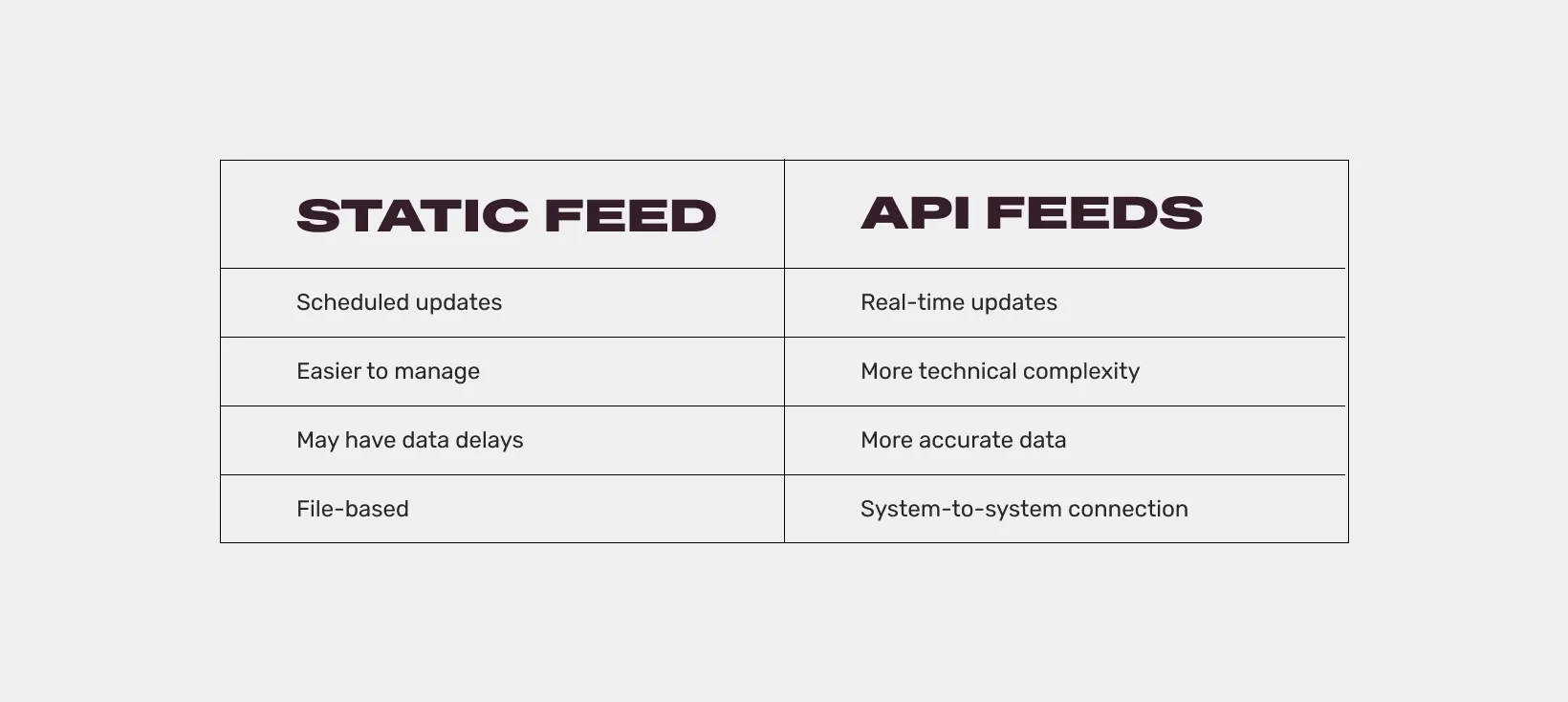
Static feeds update on a schedule. They are generally easier to manage and simpler to debug. API feeds update as changes occur, which improves accuracy but adds technical complexity.
In practice, many businesses use a combination of both. Static feeds may handle less volatile data. APIs are often reserved for high-impact updates like inventory or pricing.
Choosing between them depends on how often your data changes and how sensitive your ads or listings are to delay.
Where API Data Feeds Matter Most
API data feeds are most useful in environments where accuracy matters more than simplicity.
This includes large catalogs with frequent inventory changes, aggressive promotional pricing, or advertising setups that rely heavily on dynamic product data.
They are also valuable when multiple systems depend on the same source of truth and delays create downstream issues.
At the same time, smaller catalogs or slower-moving businesses may not need this level of synchronization. In those cases, a well-managed static feed can still perform reliably.
Managing API Data Feeds Effectively
API feeds do not remove the need for good feed management. They change where the work happens.
Data still needs to be clean at the source. Attributes still need to be completed. Category logic still matters. APIs move data faster, but they do not fix poor data quality.
Effective API data feed management often focuses on monitoring, validation, and incremental updates rather than full catalog pushes. It also requires coordination between technical teams and marketing teams so changes do not unintentionally disrupt ads or listings.
Common Challenges With API Data Feeds
API feeds introduce their own challenges.
They require technical resources to set up and maintain. Each platform has its own API specifications, limits, and error responses. Rate limits and authentication issues can interrupt data flow if they are not handled carefully.
Debugging can also be more complex. When something breaks, the issue may live in logs or error responses rather than a visible file.
These challenges are manageable, but they are real. API data feed management is a trade-off between immediacy and complexity.
How API Data Feeds Support Advertising
Advertising platforms rely on product data to build shopping ads, catalog formats, and dynamic placements. The more accurate and timely that data is, the better those systems perform.
API feeds help ensure ads reflect current prices and availability. This reduces mismatches, disapprovals, and wasted spend.
However, accurate data alone does not guarantee strong performance. It ensures correctness, not effectiveness.
That distinction becomes more important as catalogs scale.
Where API Feeds Stop and Creative Begins
Once product data is flowing correctly, a different limitation often appears. Ads may be accurate, but they can still underperform.
Catalog ads frequently reuse the same layouts and visuals. Even with perfect data, creative fatigue can set in. Platforms know what products you sell, but they still need compelling presentations to earn attention.
This is where feed management and creative workflows intersect.
Marpipe and API Data Feed–Driven Ads
Marpipe sits on top of your existing feed infrastructure, whether that feed is powered by static files or APIs. It uses your product data as input, not as a replacement.
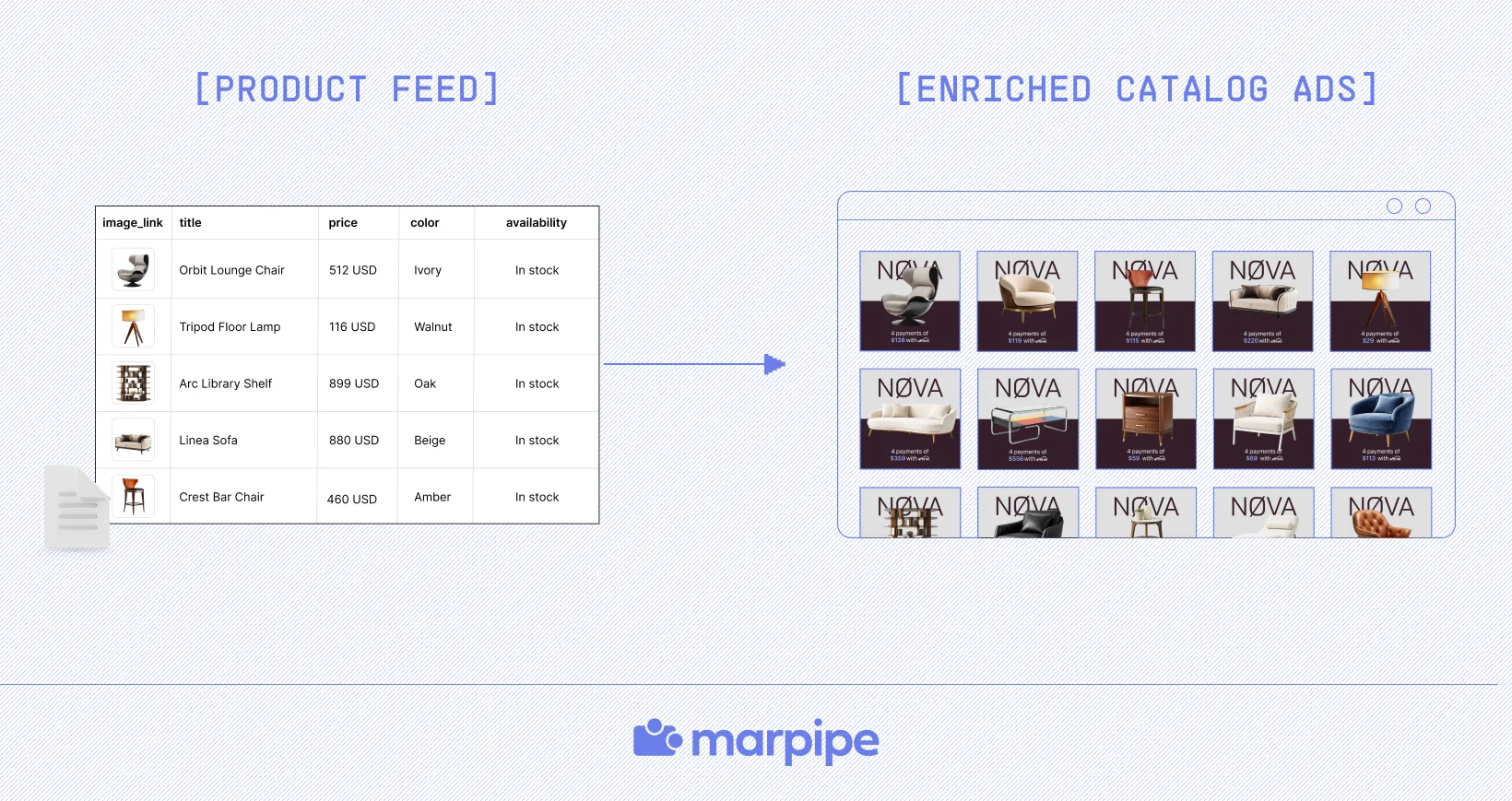
By connecting to your catalog data, Marpipe generates and tests multiple creative variations automatically. Product attributes are mapped into creative elements, allowing teams to test layouts, messaging, and visuals at scale using the same underlying feed data.
This turns accurate, up-to-date product data into a creative testing engine rather than a static input.
Book a demo with Marpipe today!
FAQs
What is API data feed management?
API data feed management is the process of sending product data directly between systems in near real time using APIs.
How is an API data feed different from a static feed?
Static feeds update on a schedule, while API feeds sync changes automatically as product data updates.
When should an ecommerce business use API data feeds?
API feeds are most useful for large catalogs, frequent price or inventory changes, and dynamic advertising setups.
Do API data feeds improve ad performance?
They help ensure ads show accurate pricing and availability, which reduces disapprovals and wasted spend.
Does Marpipe replace API data feeds?
No. Marpipe uses existing feed data, whether API-based or static, to generate and test catalog ad creatives at scale.