

Catalog ads are incredibly popular, but they look like database output: product, price, white background, next card. That can work for some, but it is not efficient, it’s ugly, and it’s not a strategy.
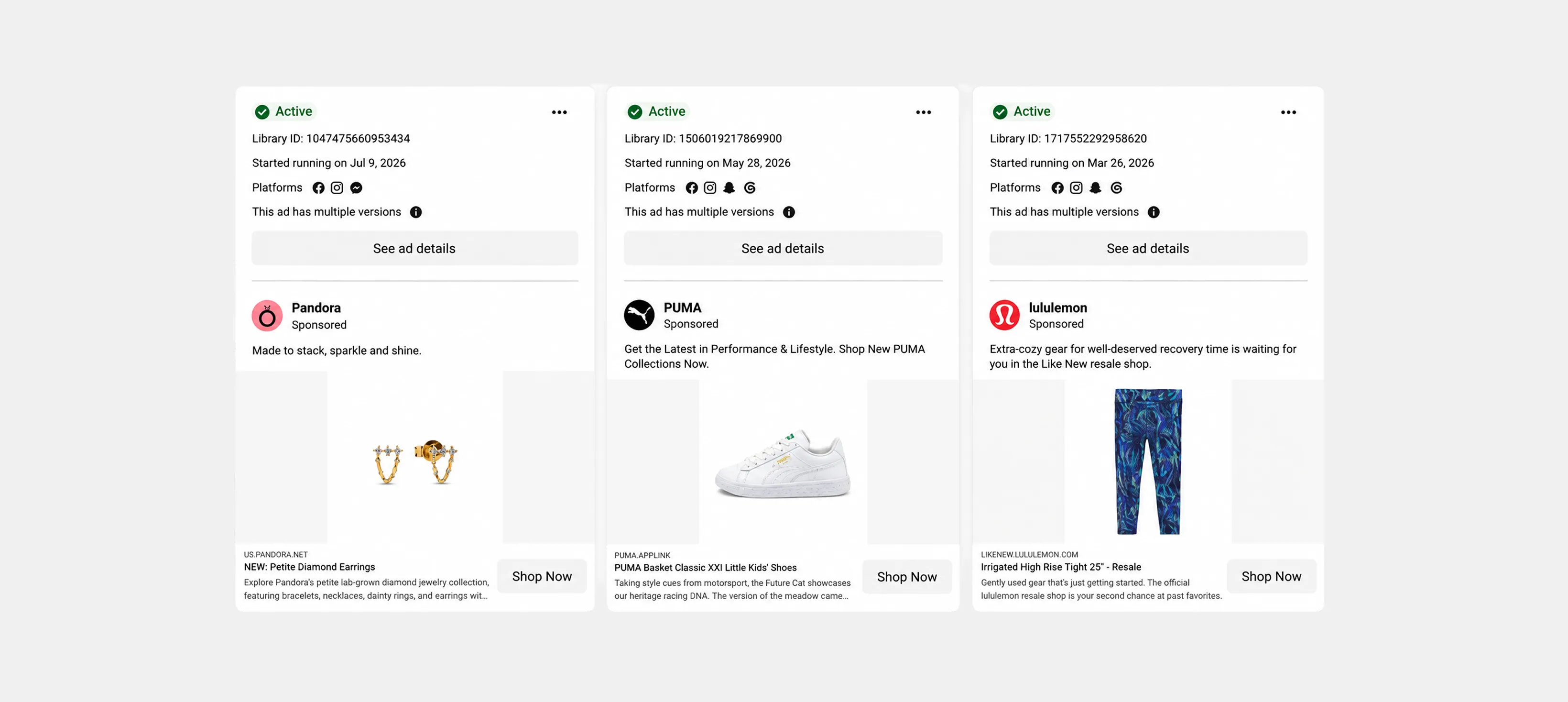
Catalog ads like this account for 40% of Meta’s global ad revenue. Soon, they might become more popular than static image or video ads.
But how are they so popular if they look so bad? When you upload a regular image or video as an ad, you’re not telling the algorithm much about what you’re selling. But when you upload a well-organized, data-rich product catalog, you’re feeding the algorithm 10x more critical information about what you’re selling. This alone substantially improves the algorithm’s ability to show your product images to the right person, at the right time.
For the past 7 years, my company Marpipe has been running catalog ads for thousands of the world’s largest and fastest-growing brands. We oversee over $1bn+ in ad spend per year going to catalog ads (on Meta alone).
I’ll summarize everything we’ve learned into 7 simple principles for your team to follow.
Rule #1: Catalog ads are mainly for prospecting.
Catalog ads used to only work well for retargeting. Today, that notion is very outdated. Meta supports Advantage+ catalog ads for broad audiences, which serves your products to people who have never heard of you before.
The more data in your feed, and the more context in your feed images, the better the prospecting results.
The catch is that a cold prospect needs context. A plain product tile assumes the viewer already understands the brand, category, and reason to care. For prospecting, use catalog-level primary copy, a restrained frame or overlay, or a carousel intro card to explain the value proposition before asking someone to browse products. Meta specifically recommends new-customer-relevant creative and suggests an intro card for carousel executions.
A strong cold-audience catalog ad should answer three questions immediately: What is this? Who is it for? Why should I care now?
You can do this effectively by including lifestyle imagery or social proof in your catalog images (Marpipe enables this).

Rule #2: Include all your products by default. Then, test product sets.
Catalog programs become fragile when every category has its own campaign, audience, feed rule, template, and offer. Meta generally recommends using the largest relevant product set—often the default All Products set—because a broader pool gives the delivery system more opportunities to find the right item for each person.
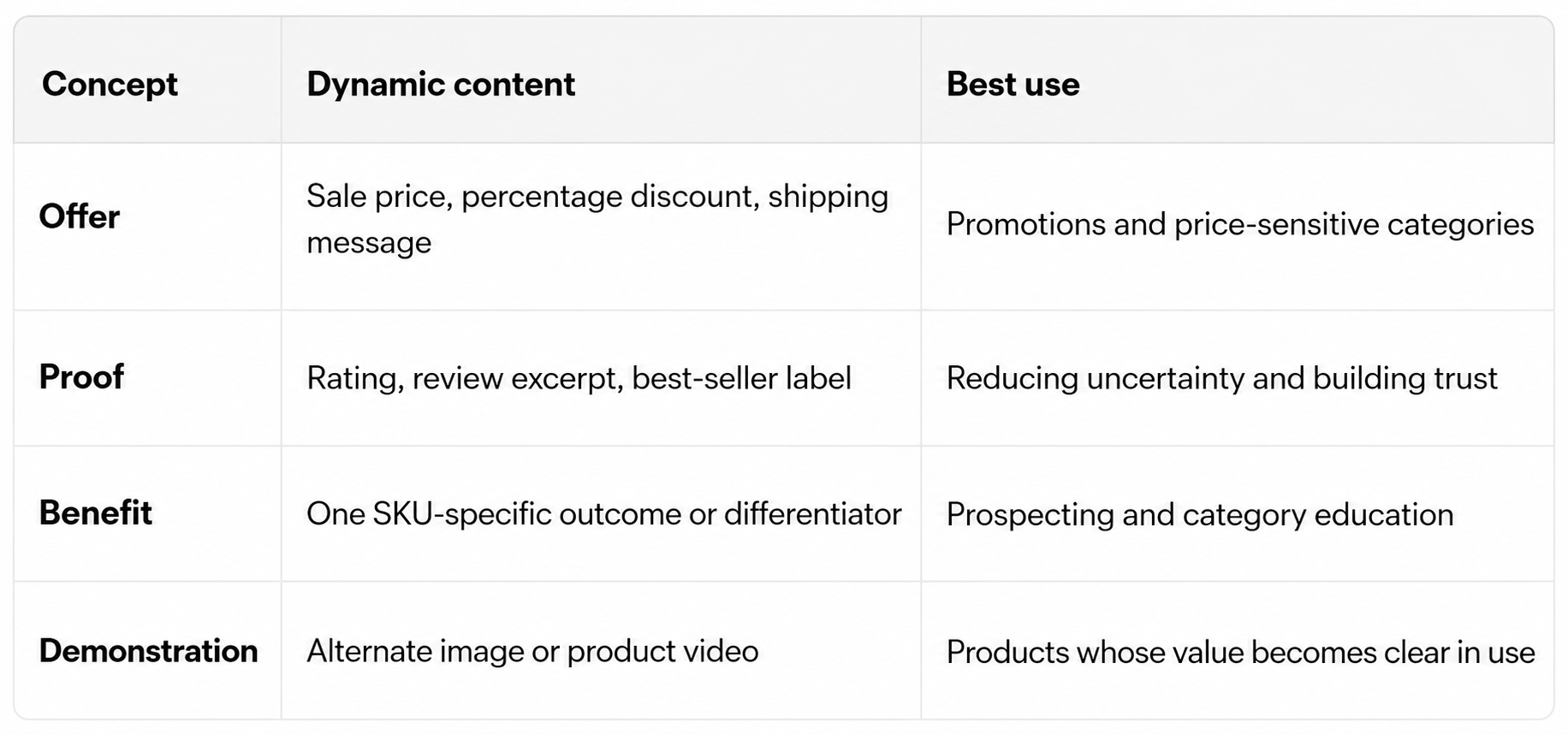
Creative should be simple too. Start with a small number of repeatable concepts: offer, proof, benefit, and product demonstration. The product remains the hero; the template supplies only the context needed to make the product more compelling.
Rule #3: If you never switch your source feed, you never reset learnings.
A really unique feature of catalog campaigns is that algorithmic learnings accumulate at the feed level. Not at the ad level.
You can make changes to your catalog campaigns using the supplementary feed section, and NEVER have to reset learnings. Every time you replace your source feed, you risk forcing the system to rebuild its understanding of your products from scratch. The product IDs, engagement history, conversion signals, and item-level performance associated with the existing feed are part of what helps Meta decide which products to show and to whom.
Treat your source feed as the permanent foundation. Improve titles, images, labels, prices, and creative inputs inside it—but avoid creating a new feed every time you want to test something. Preserve the same item IDs and underlying catalog structure so new creative benefits from the learnings already attached to each product.
Rule #4: Build a rule-based system for your catalog creative.
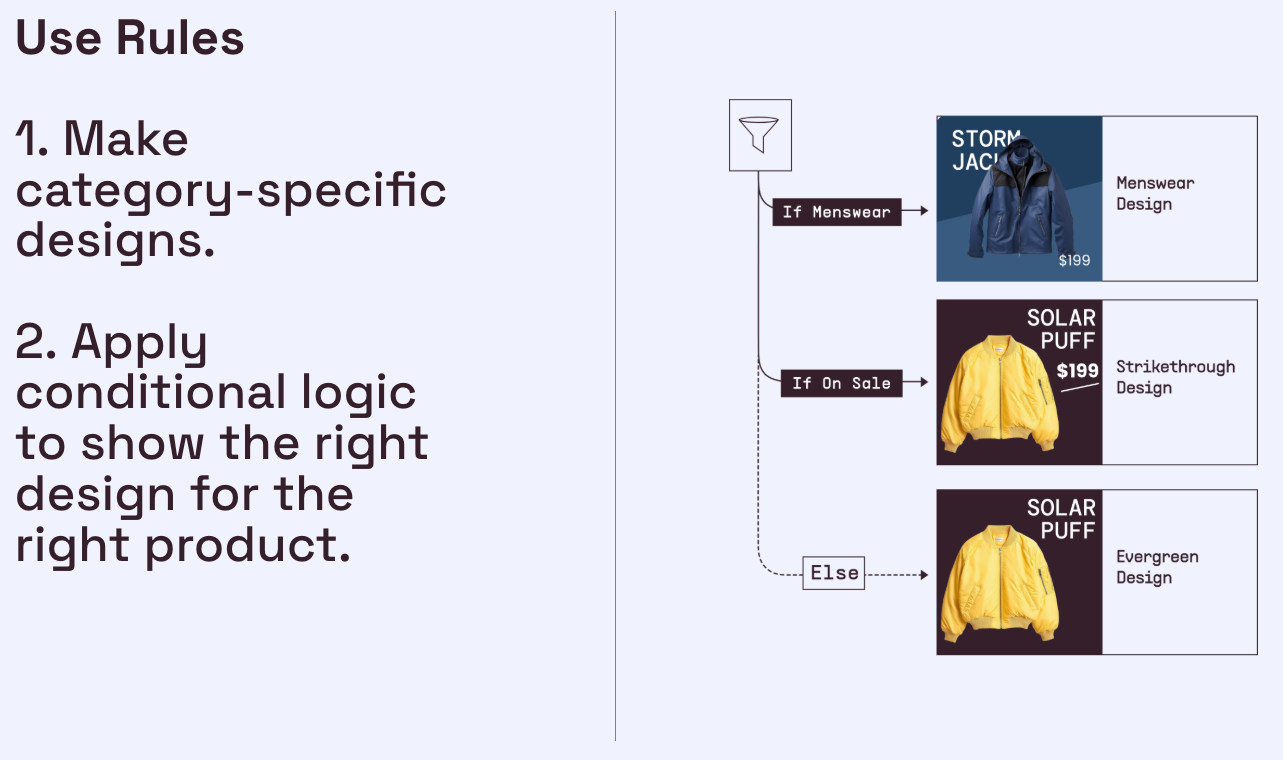
Catalog creative should not depend on someone manually deciding how every SKU should look. Build rules that automatically match each product with the most appropriate message, image treatment, offer, and template.
A discounted item might receive a sale-price frame. A product with strong review volume might use a proof-led template. A new arrival might receive a launch treatment, while an overstocked item receives a more aggressive offer. Rules can also account for category, margin, inventory, season, image type, video availability, and customer rating.
This turns creative production from a collection of one-off designs into an operating system. The feed supplies the data, the rules choose the treatment, and the template produces the creative at scale.
Rule #5: Launch CPV immediately (Catalog Product Video)
In the grand scheme of things, video catalog ads are new. Meta only introduced them in 2025.
But in order to run these, you need a unique video for every SKU. Which most brands don’t have. Marpipe can generate these for you.
Catalogs that have a video column included in them perform 20% better than those that don’t - according to Meta’s marketing science team. This alone should be enough to justify the effort.
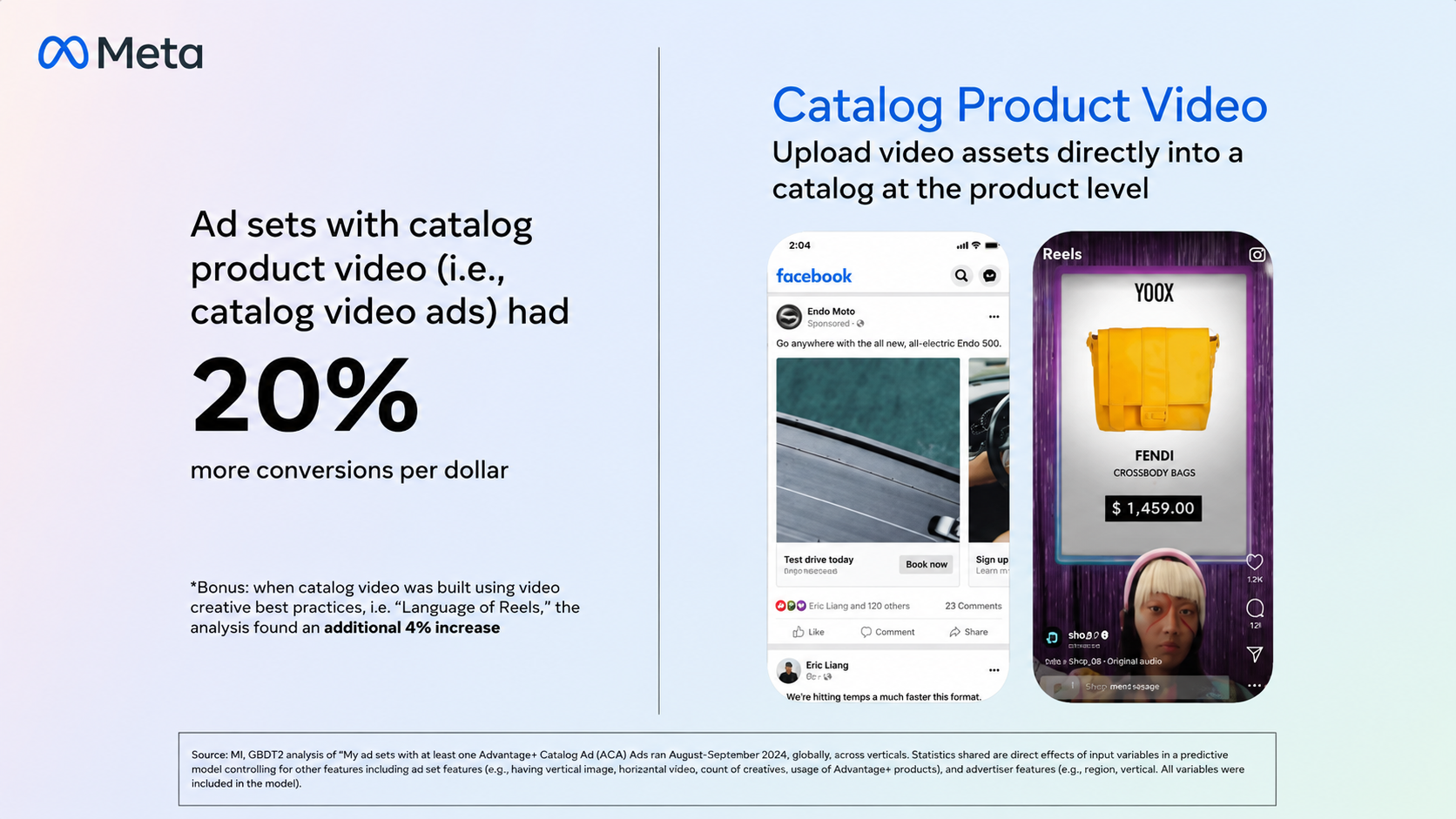
Video gives the delivery system another way to present each product. A simple demonstration, rotating product shot, customer clip, or image-based animation can reveal fit, scale, movement, texture, and use cases that a static image cannot. Even partial video coverage lets you learn which categories and products benefit most from motion.
Rule #6: Automate emotional relevance.
Dynamic delivery is good at matching a product with a buyer. It does not automatically explain the emotional reason to buy it.
Build product groupings and message variants around customer situations: first day at a new job, pain-free travel, confidence at an event, a calmer bedtime, or a faster morning routine. Use broad catalog delivery by default, then create narrower product sets only when the emotional promise genuinely applies to every included SKU and the hypothesis is worth isolating.
The product selection answers “Which item?” The copy and creative system must answer “Why this matters to me.”
Rule #7: Channel diversify.
Meta and Google are really good at catalog ads. But their competitors are catching up. Reddit, Snap, Pinterest and AppLovin are all channels that recently overhauled their catalog ads offering to make it way more competitive.
The same product data, enriched attributes, image variants, video assets, and creative logic can support other commerce channels. But each channel requires its own format, behavior, and message hierarchy, so the goal is not to publish identical assets everywhere. The goal is to create one reliable source of product truth and adapt its outputs to each platform.
A proof-led concept that wins on Meta might become a product video on TikTok, a shopping pin on Pinterest, or an enriched listing image on a marketplace.
Channel diversification with catalog ads is an easy way to find unexpected value. Centralize the product intelligence; customize the execution.
That’s it.
If your team can internalize these 7 rules, you'll scale your catalog campaigns much faster and be leagues ahead of your competition. Happy scaling!