

Brief Definition
UGC is content created by customers or creators that brands repurpose in ads. It feels native and authentic when done right.
What is UGC? A Detailed Guide for 2026
User-generated content is any content about a brand or product created by people who are not the brand itself. It’s not studio-produced. It’s not polished agency creative. It’s real users documenting their experience.
If you’ve spent time on TikTok, Instagram, or YouTube lately, you’ve seen UGC. Maybe you just didn’t label it that way. Someone filming a quick product review in their bedroom. A customer showing how they style a jacket they bought. A casual unboxing video recorded on a phone. That’s UGC.
At its simplest, is content made by customers, fans, or everyday users instead of the company behind the product.
It might be:
- A written review
- A tagged Instagram post
- A before-and-after video
- A tutorial
- A reaction
- A testimonial
If the brand didn’t make the content, then it’s UGC.

Why does UGC matter?
Because people trust other people more than they trust marketing.
That isn’t new. What has changed is how platforms distribute content. Social feeds blur the line between ads and posts. Content that looks native often performs better than content that feels obviously promotional.
UGC blends in. It feels like something a friend might share. That familiarity lowers resistance. And in advertising, lower resistance often means higher engagement.
UGC in organic vs paid contexts
UGC shows up in two major ways.
First, organically. Customers post about products because they like them, dislike them, or want to share their experience. This type of UGC builds social proof without direct brand involvement.
Second, inside paid advertising.
This is where the term gets slightly stretched. Brands now commission creators to produce content that looks organic but is designed for ads. These pieces are technically sponsored, but they follow the same casual structure as organic UGC. A creator talking to camera, a quick demo, a story about solving a problem. The format mirrors everyday content consumption patterns.
The shift toward UGC-style ads
A few years ago, high-production creative dominated paid social. Clean lighting. Scripted voiceovers. Perfect edits. That approach still has a place. But audiences adapted. Highly polished ads became easier to ignore. UGC-style creative filled the gap.
In 2026, many ecommerce brands rely heavily on creator-style UGC for:
- Meta ads
- TikTok campaigns
- YouTube Shorts placements
- Retargeting sequences
Not because it’s trendy, but because it often performs well relative to cost. It feels less like interruption and more like participation.
What makes UGC work
It’s not just the camera quality. UGC works when it reflects real use cases. Specificity matters.
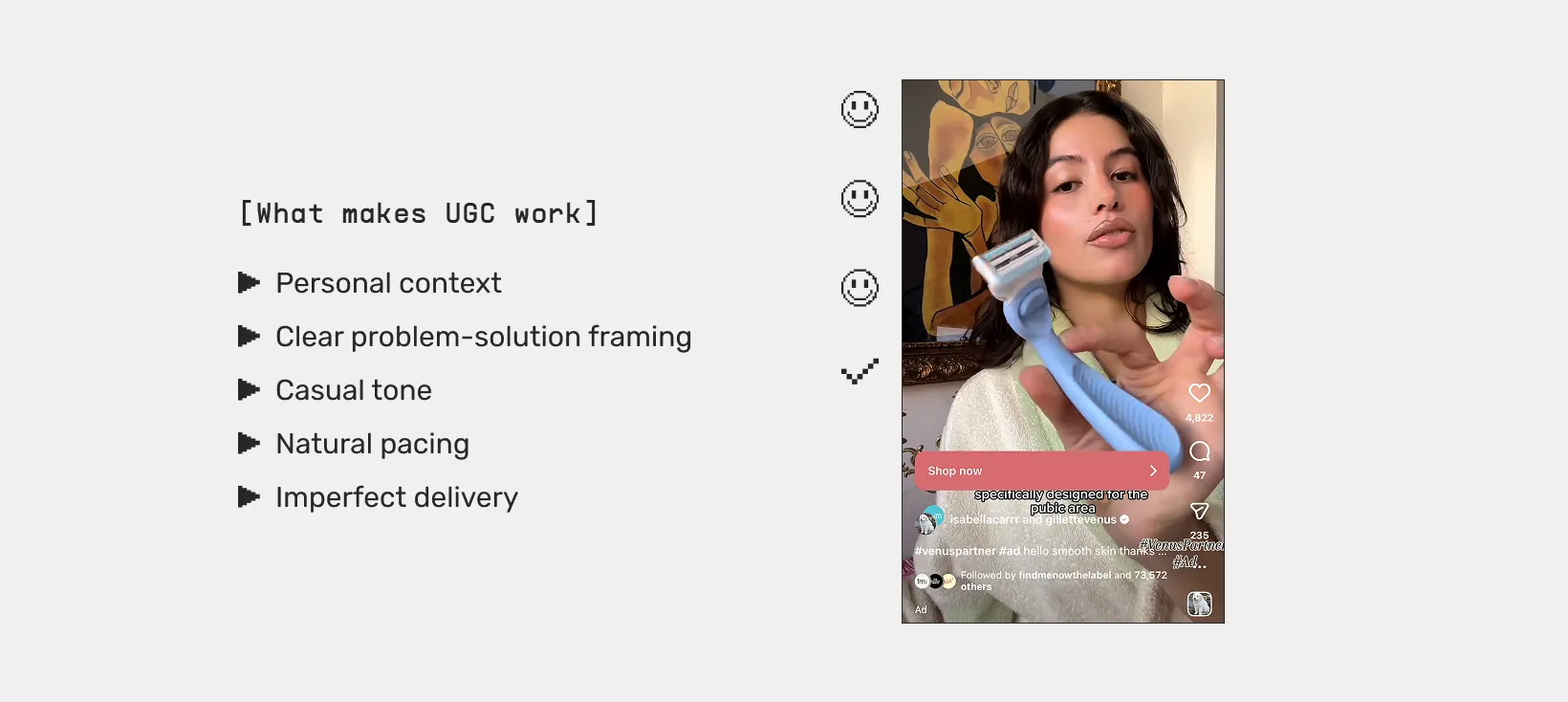
Instead of broad product claims, strong UGC often includes:
- Personal context
- Clear problem-solution framing
- Casual tone
- Natural pacing
- Imperfect delivery
The imperfections are part of the appeal. That said, authentic doesn’t mean careless. The best UGC still communicates clearly and respects platform norms.
Common forms of UGC in 2026
UGC has expanded beyond simple reviews.
You’ll see:
- Customer testimonials
- Side-by-side comparisons
- Day-in-the-life integrations
- Unboxings
- Voiceover walkthroughs
- Reaction-style commentary
Some brands now build recurring creator programs to maintain a steady flow of UGC-style assets. Instead of waiting for organic content to appear, they create structured systems for sourcing it.
UGC vs influencer content
These terms overlap, but they are not identical. Influencer content is produced by individuals with established audiences. UGC can come from anyone.A creator with 300 followers filming a product demo can produce high-performing UGC.
In paid media, follower count often matters less than relatability and performance.Brands increasingly prioritize creative effectiveness over audience size.
Where brands get UGC
There are a few consistent approaches:
- Encouraging customers to tag the brand
- Creating hashtag campaigns
- Running giveaways
- Sending product to micro-creators
- Partnering with UGC marketplaces
- Building internal creator networks
Some brands combine organic sourcing with structured creator outreach. The goal isn’t just collecting content. It’s ensuring consistent creative input.
How Does UGC Impact Performance Marketing?
UGC often enters the conversation because of performance.
It tends to:
- Blend naturally into feeds
- Increase watch time
- Lower cost per acquisition in some verticals
- Improve engagement rates
But performance depends on iteration, one strong UGC ad is not enough, creative fatigue still applies. Teams that treat UGC as a repeatable testing input, not a lucky hit, see more consistent results.
4 Mistakes brands make with UGC
- Relying on a single winning asset for too long.
- Over-scripting content until it loses authenticity.
- Ignoring rights management and permissions.
- Assuming that because the content looks real, it will automatically convert.
UGC still needs testing. It still needs measurement. The format does not replace strategy.
How to Measure UGC performance
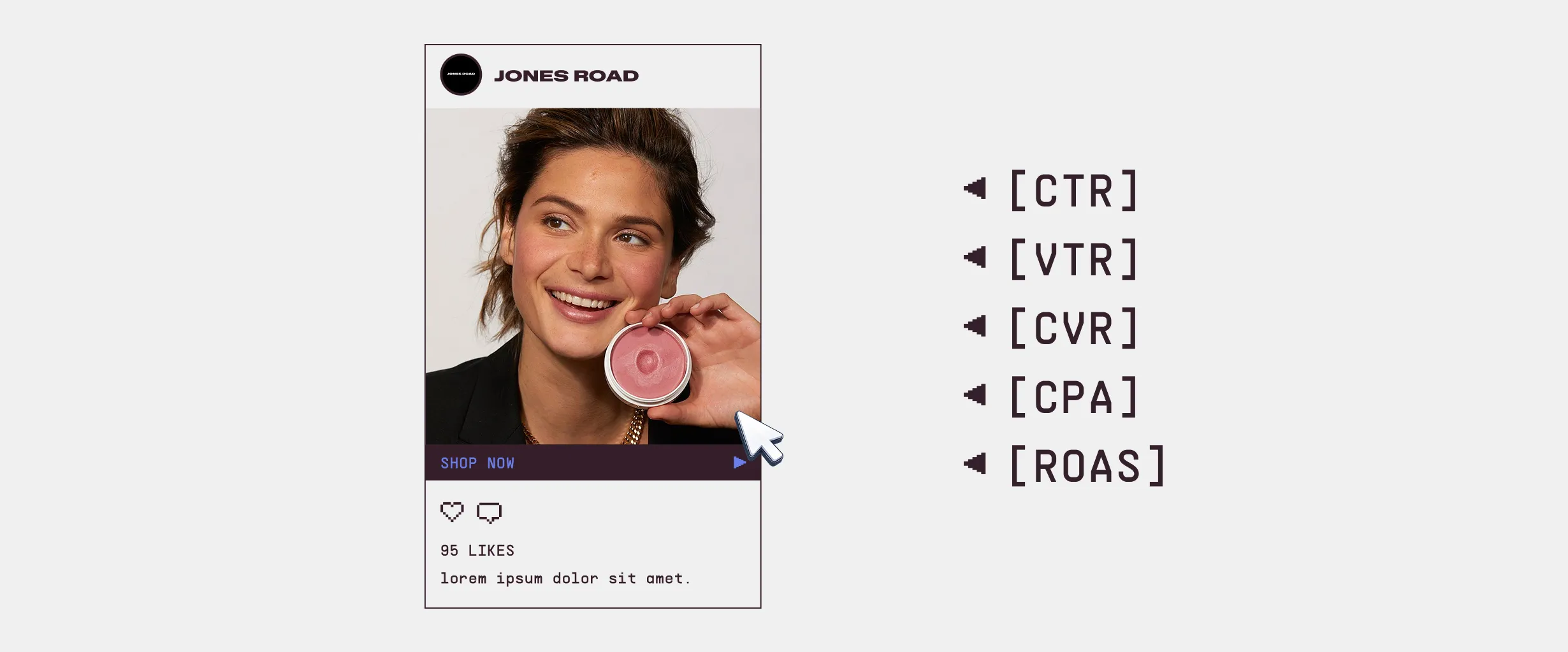
Like any creative format, UGC should be evaluated using data. Common performance signals include:
- Click-through rate
- View-through rate
- Conversion rate
- Cost per acquisition
- Return on ad spend
UGC sometimes outperforms traditional creative. Sometimes it does not. When it does work, it’s often because it aligns closely with how users already consume content on the platform.
Why UGC remains relevant
Digital advertising continues to automate targeting and delivery. That makes creative differentiation more important.
UGC introduces variation naturally. Different faces. Different voices. Different settings. It adds texture to a brand’s presence. And because it originates from real users or creators, it often carries an underlying credibility that brand-produced assets struggle to replicate.
Turn UGC Into a Creative Testing Engine With Marpipe
UGC often performs well because it feels authentic. But authenticity alone does not guarantee results. Performance comes from testing: different hooks, different creators, different problem statements, different formats. The brands that see consistent lift from UGC are not relying on a single viral clip. They are building systems to test variations deliberately and learn quickly. That’s where Marpipe comes in.
Marpipe helps ecommerce teams turn creative concepts, including UGC-style assets, into structured, testable ad variations at scale. Instead of guessing which version will resonate, you can compare layouts, messaging angles, and creative combinations systematically.
UGC can be powerful. But its real value appears when it is part of a repeatable testing framework.
If you want to move beyond one-off creative wins and build a system around performance, book a demo to see it in action.