

Brief Definition
Contribution margin is revenue minus variable costs (COGS, shipping, payment fees, variable ops). It shows how much is left to cover fixed costs and profit.
What is Contribution Margin?
Contribution margin is the revenue remaining after subtracting variable costs. Nothing more complicated than that. Revenue minus the costs that move when sales move.
If you sell one more unit, and that sale triggers costs like product manufacturing, packaging, shipping, transaction fees, or marketplace commissions, those are variable costs. Subtract them. What remains contributes to the business.
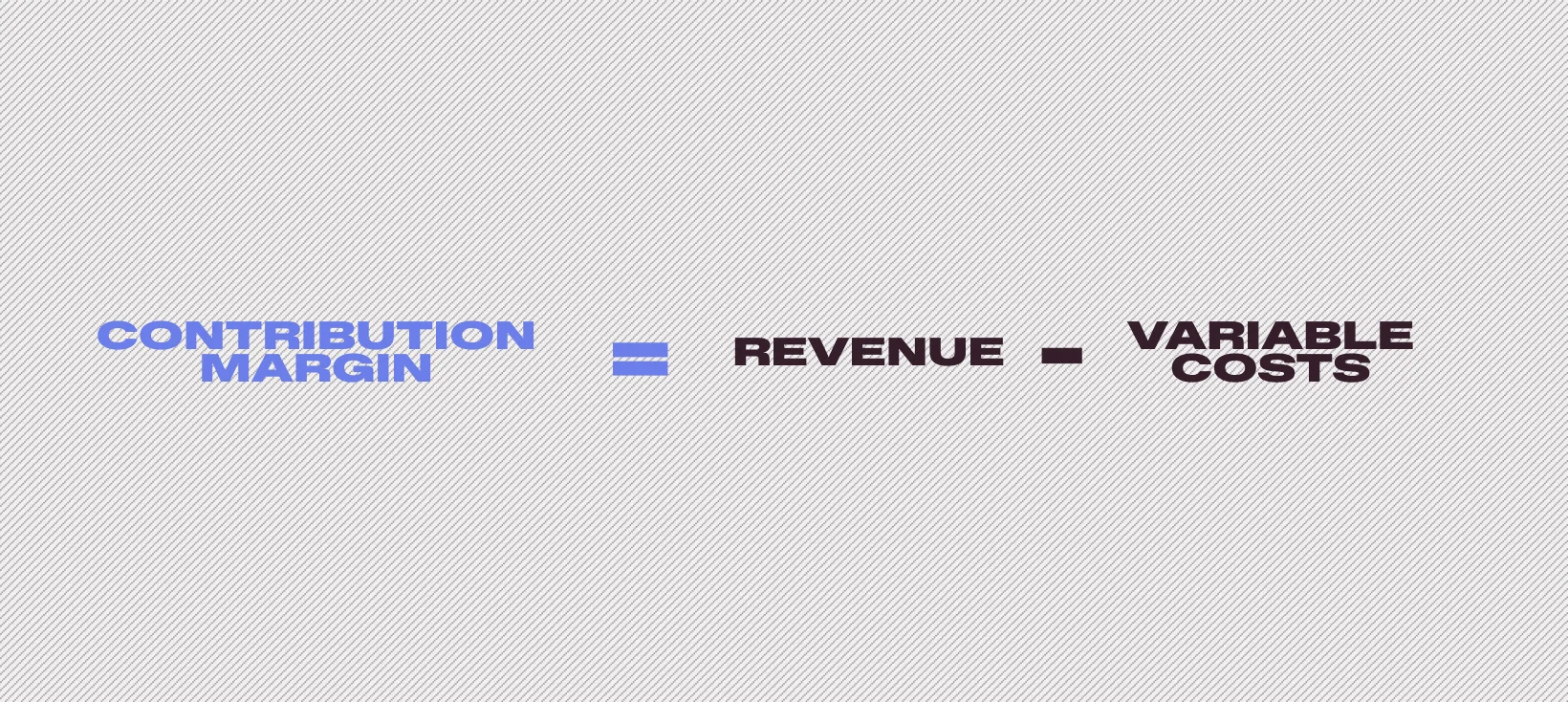
Contribution Margin = Revenue – Variable Costs
It sounds basic. It is basic. But it’s often overlooked.
Why people might confuse Contribution Margin with other metrics
Many teams rely heavily on ROAS, revenue growth, or even gross margin. Those numbers are useful. They just don’t always tell you whether a sale meaningfully improves your position.
Gross profit may include allocations that don’t truly vary per unit. ROAS ignores fulfillment. Revenue ignores everything.
Contribution margin forces you to isolate the economics of a single incremental sale. That’s where its value lies.
What actually counts as a variable cost?
This is where mistakes happen. A cost belongs in the contribution margin only if it changes when you sell one more unit.
Common examples:
- Cost of goods sold
- Packaging tied to the sale
- Shipping per order
- Payment processing fees
- Marketplace commissions
- Sales-based affiliate fees
- Variable advertising costs are directly tied to conversions
Costs like office rent, salaried employees, annual software contracts, and utilities typically do not move with each sale. Those are fixed.
If you accidentally include fixed costs, the contribution margin shrinks artificially. If you exclude true variable costs, it inflates. Precision matters.
A practical example
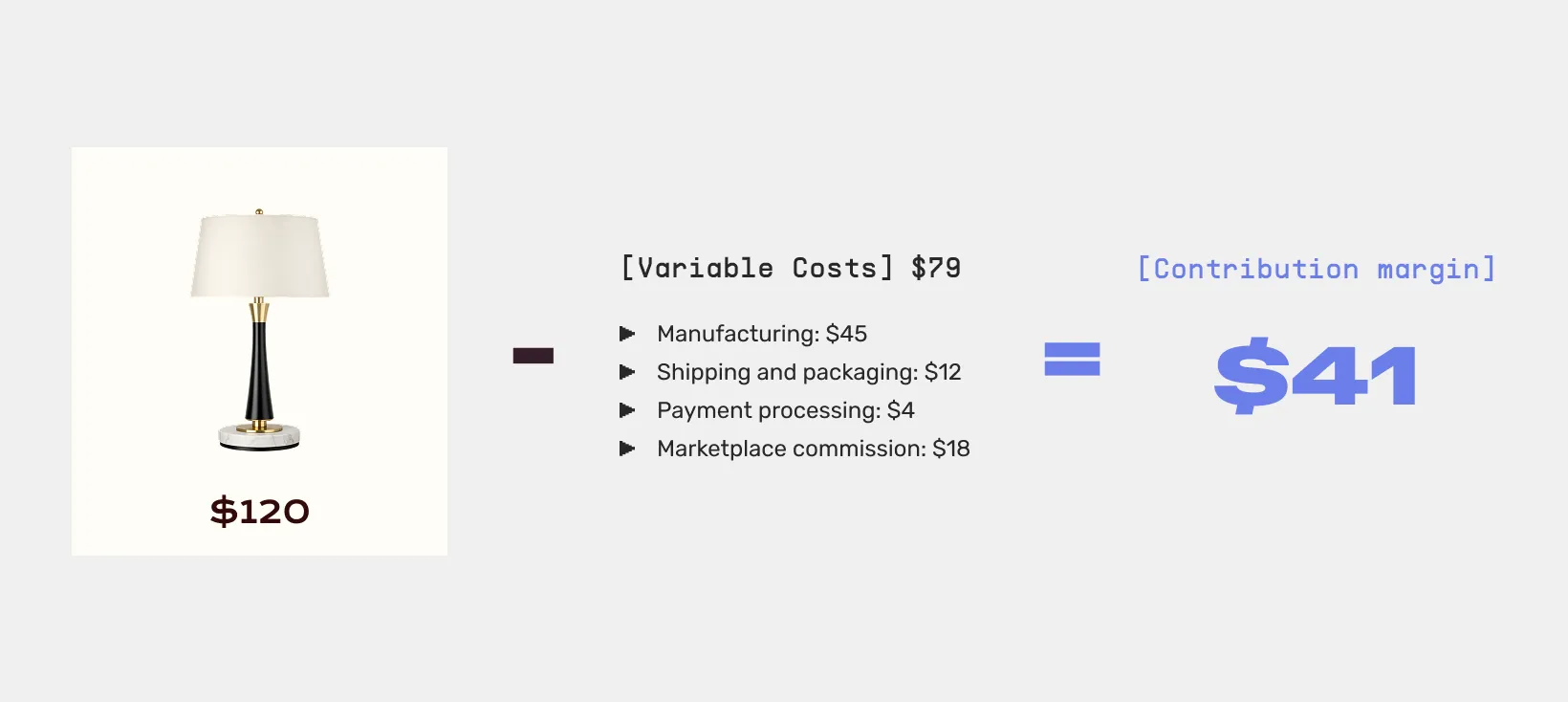
Let’s say you sell a desk lamp for $120.
Your costs look like this:
- Manufacturing: $45
- Shipping and packaging: $12
- Payment processing: $4
- Marketplace commission: $18
Total variable cost: $79
Contribution margin: $120 – $79 = $41
So $41 from each sale is available to cover fixed costs and profit.
Now, imagine you lower the price to $100 to drive more volume.
New contribution margin: $100 – $79 = $21
Volume might increase. But each sale now contributes almost half as much. That tradeoff becomes clearer when you look at contribution margin instead of just revenue.
Why is the contribution margin crucial in 2026
Businesses are operating across more channels than ever. Marketplaces. Paid social. Search. Affiliate networks. Each carries a different fee structure.
Revenue might grow. But margins can quietly shrink. Contribution margin helps you see that erosion early. It also helps during:
- Discounting strategies
- Dynamic pricing adjustments
- New channel launches
- Product mix evaluations
- Inventory prioritization
It gives clarity when top-line numbers look healthy, but profitability feels tight.
Contribution margin vs gross margin
They overlap, but they’re not identical. Gross margin usually subtracts the cost of goods sold. Contribution margin subtracts all variable costs.
If your fulfillment or transaction fees scale with each sale, gross margin might look solid, while contribution margin tells a different story. That difference is especially visible in ecommerce, where per-order costs can vary significantly by channel.
Where the contribution margin becomes powerful
Contribution margin becomes most useful when you compare things that look similar at first glance.
- Two products can have similar revenue.
- Two campaigns can show similar ROAS.
But their contribution margins may differ meaningfully.
One might incur higher shipping costs. Another might incur higher platform fees. One may have a higher return rate that eats into the contribution. Looking only at revenue would hide that.
A slightly more complex scenario
Consider two products:
Product A
Price: $80
Variable costs: $50
Contribution: $30
Product B
Price: $150
Variable costs: $110
Contribution: $40
Product B generates more revenue and more contribution per unit.
But if Product A sells three times as often with lower return rates, the overall contribution picture changes.
Contribution margin works best when paired with volume analysis. It is not a standalone metric.
Common mistakes when Measuring Contribution margin
A few patterns show up repeatedly.
- Ignoring returns and refunds
Returns often carry shipping and restocking costs that are variable. Leaving them out inflates the contribution. - Blending fixed and variable costs
Be disciplined. Not every expense belongs in this calculation. - Looking only at overall averages
A blended contribution margin may hide underperforming SKUs or campaigns. - Assuming positive contribution equals profit
Contribution margin must still cover fixed costs before profit exists.
Contribution margin in marketing decisions
Contribution margin adds a layer of realism to marketing analysis. A campaign may show a 3x ROAS, but if the underlying product carries a thin contribution after variable costs, scaling it aggressively may not improve net profitability.
Another campaign may show lower revenue but stronger per-unit contribution. That campaign might deserve more budget. This is where contribution margin reshapes decision-making. It connects marketing metrics to business fundamentals.
How to start using it consistently
You don’t need complex modeling to start.
- Calculate the contribution margin per major product
- Segment it by channel
- Compare it before and after the pricing changes
- Include it in campaign reviews alongside ROAS
Over time, patterns emerge. Certain SKUs may consistently deliver strong contribution. Others may require pricing or cost adjustments. Without contribution margin, those patterns stay hidden.
Increasing Contribution Margins through better creative performance with Marpipe
Contribution margin is not a complex concept. It is revenue minus the costs that move with sales. But that simplicity is deceptive.
Used consistently, it becomes one of the most grounding metrics in performance analysis. It helps you compare products fairly. It exposes weak pricing decisions. It prevents overconfidence in revenue spikes. And perhaps most importantly, it connects marketing outcomes to economic reality.
Contribution margin connects marketing metrics to real business economics. It shows you where profit potential exists. The next challenge is increasing that contribution through better creative performance.
Marpipe enables ecommerce teams to test catalog ads systematically, helping uncover the creative combinations that improve results without guessing.
See how Marpipe can support your performance strategy and book a demo today.